
www.aero-defence.tech
25
'26
Written on Modified on
Leonardo and Baykar Complete K-SWARM Autonomous Flight Trials
Leonardo and Baykar partner to develop and validate Crewed/UnCrewed Teaming (CUC-T) interoperability using M-346 and KIZILELMA aircraft.
baykartech.com
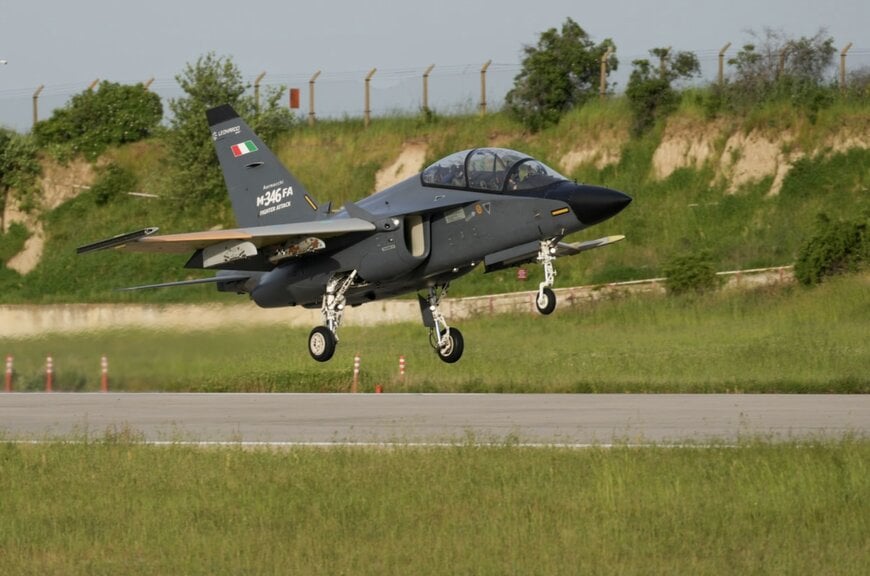
Leonardo and Baykar have successfully completed the first phase of live testing activities for the K-SWARM programme. The trials involved a series of joint autonomous formation flights to assess, validate, and advance collaborative combat teaming and swarm tactics between crewed and uncrewed aircraft.
Context of the Cooperation
Collaborative combat teaming has increasingly become a key enabler for future combat air systems and a core pillar in the evolution of current-generation fighter aircraft. Designing and implementing Crewed/UnCrewed Teaming (CUC-T) introduce significant operational, doctrinal, and industrial complexities.
No single company can easily scale and integrate the diverse hardware systems, avionics suites, and flight control software required for safe, high-performance autonomous formation flight. To address these integration challenges and deliver scalable tactical solutions, Leonardo and Baykar established a strategic partnership. The collaboration combines Leonardo's flight control innovation, simulation platforms, and avionics suites with Baykar's specialized smart fleet autonomy capabilities and uncrewed combat aircraft technology. This joint approach allows the companies to transition advanced algorithms from a simulated environment into real-world, multi-domain operational scenarios.
Technical Solution and Responsibilities
The technological core of the K-SWARM programme relies on a dedicated computing system that enables high-performance combat platforms to synchronize and coordinate autonomously. Responsibilities are divided between the partners to merge aircraft piloting frameworks with advanced fleet automation:
Leonardo developed the next-generation algorithms, relevant tactics, and procedures at its Avionic and Flight Control Innovation Labs and its product capability and concept laboratory (PC2LAB) in Turin, Italy. Leonardo also provided the crewed flight hardware and simulation assets, including an M-346 Full Mission Simulator in Venegono, Italy.
Baykar integrated smart fleet autonomy capabilities into the CUC-T algorithms at its Hardware-in-the-Loop (HIL) Laboratory. Baykar provided the uncrewed fighter platform and state-of-the-art software and hardware systems to simplify and execute the integration process.
At a system level, the architecture unifies multiple software and hardware layers to perform autonomous maneuvers. An advanced radio frequency data exchange system synchronizes all telemetry and data shared between the platforms. This transmission layer is protected in real time by the Leonardo GCC Tactical Platform—a proprietary cyber defence platform that monitors and secures systems to maintain effective command and control of the flight formations.
During flight, the system functions by allowing Smart Fleet Autonomy algorithms to manage the uncrewed fighter. Following an autonomous taxi and take-off, the uncrewed aircraft rejoins the crewed lead plane. Using a newly developed, fully integrated onboard avionic suite and a dedicated crewed/uncrewed computing system, pilots inside the crewed aircraft command diverse formations—such as position changes, separations, and rejoins—which are executed autonomously and accurately by the uncrewed wingman.
Deployment or Implementation
The implementation strategy follows a structured digital engineering approach, bridging intensive laboratory preparation with physical field validation. The engineering teams spent months establishing technical integration, developing test scenarios, and validating algorithms across interconnected simulators in Italy and Turkey.
The live flight test campaign was deployed in May at one of Baykar’s flight and test centers in Çorlu, Türkiye. The field trials utilized three physical aircraft: two Leonardo M-346 airplanes (a Leonardo-owned M-346 Fighter Attack Variant and an Italian Air Force T-346A acting as a chase aircraft) and the Bayraktar KIZILELMA Uncrewed Fighter Aircraft.
The successful completion of these formation flights validates the collaborative procedures and marks the transition of the K-SWARM programme from simulation to live operations. The data and analysis gathered from this phase are being used to define subsequent development steps. Future implementation phases are planned in the coming months, which will feature increasing complexity and additional functions aimed at incrementally shifting uncrewed platforms from remote piloting to full autonomy.
Edited by Romila DSilva, Induportals Editor, with AI assistance.
www.baykartech.com
