
www.aero-defence.tech
22
'26
Written on Modified on
Integrating industrial filtration systems with operational aviation infrastructure
Brussels Airport and Safran Aero Boosters are testing a mobile prototype to reduce fine particulate matter on the tarmac.
www.safran-group.com
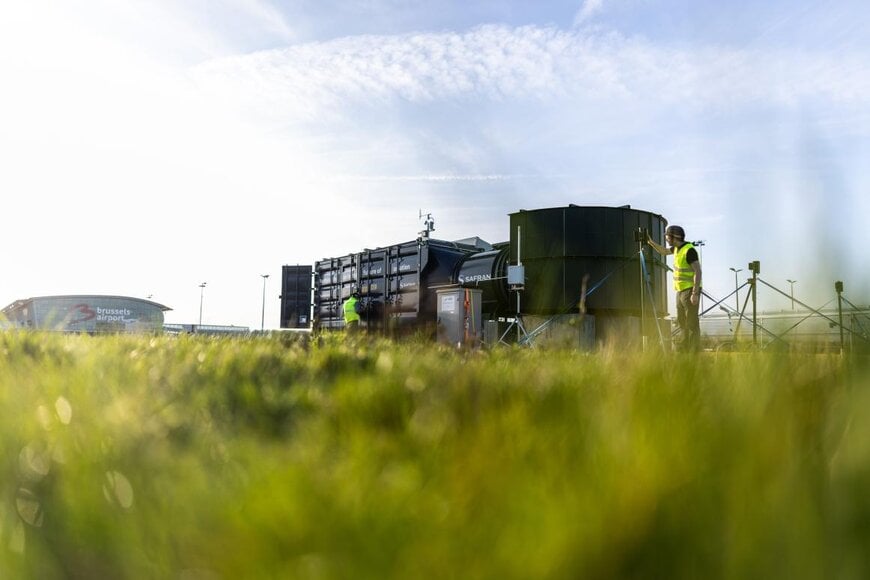
The technical cooperation integrates advanced airflow treatment systems with real-world aviation operations to mitigate localized particulate emissions. The project transitions industrial emission control technologies into active airfield environments, targeting occupational safety and environmental monitoring within digital infrastructure and modern logistics networks.
Particulate concentration bottlenecks in operational airfield zones
Aviation tarmac environments face complex air quality challenges due to ground support equipment, aircraft taxiing, and auxiliary power unit operations. These activities release high concentrations of fine and ultrafine particles into the ambient air, presenting an operational challenge for facility management.
Traditional stationary building filtration systems cannot capture emissions generated directly on open tarmacs. Standard fixed ventilation architectures are incapable of treating dynamic, high-volume outdoor airflows without obstructing ground operations or requiring costly, permanent structural modifications to pre-existing airfield aprons.
Fluid dynamics and industrial filtration mechanisms
The joint technical solution utilizes a high-capacity mobile filtration platform housed within a standard 12-meter shipping container. Safran Aero Boosters designed the prototype by adapting internal fluid mechanics, airflow control engineering, and particle monitoring systems originally developed for aerospace engine test benches.
The division of execution tasks between the partners is structured as follows:
- Safran Aero Boosters components: Manages the mechanical filtration assembly, optimizes internal fan aerodynamics, and coordinates engineering sub-contracts with specialized research institutes.
- Brussels Airport components: Integrates the mobile container into active operational zones, supplies field-level electrical infrastructure, and aligns testing schedules with live flight traffic workflows.
The system functions by utilizing a powerful intake fan at the front of the enclosure to draw in ambient air. The air is forced through a multi-stage industrial filtration matrix that physically captures microscopic particles before discharging the purified stream from the rear of the device.
Phased field validation and testing protocols
The engineering validation protocol is split into distinct operational phases conducted in real-world airport settings. The initial testing phase ran from December 2025 to March 2026 directly on the tarmac in front of Pier A, focusing on initial baseline performance metrics.
The second validation phase begins on June 22, 2026, and is scheduled to operate for a three-month duration until the end of September 2026. During this cycle, the installation operates daily during peak traffic windows between 8 a.m. and 8 p.m. Parallel research organizations—including KMA Filter, the University of Liège, the von Karman Institute, GD Tech, ISSeP, and VITO—execute independent air quality measurements around the perimeter to verify particle reduction ratios without disrupting live aircraft handling loops.
Expected operational and environmental benefits
Deploying a mobile, containerized filtration solution allows airport operators to position particle extraction hardware dynamically near high-emission zones. The system stabilizes the surrounding microclimate by continuously recirculating and cleaning local air volumes, lowering the concentration of airborne contaminants without requiring permanent physical infrastructure. This localized filtering approach protects tarmac personnel from prolonged exposure to ultrafine matter, enhances regional environmental compliance, and provides reproducible performance data under the European Stargate framework for sustainable aviation design.
Edited by Sucithra Mani, Induportals editor – adapted by AI.
www.safran-group.com
Phased field validation and testing protocols
The engineering validation protocol is split into distinct operational phases conducted in real-world airport settings. The initial testing phase ran from December 2025 to March 2026 directly on the tarmac in front of Pier A, focusing on initial baseline performance metrics.
The second validation phase begins on June 22, 2026, and is scheduled to operate for a three-month duration until the end of September 2026. During this cycle, the installation operates daily during peak traffic windows between 8 a.m. and 8 p.m. Parallel research organizations—including KMA Filter, the University of Liège, the von Karman Institute, GD Tech, ISSeP, and VITO—execute independent air quality measurements around the perimeter to verify particle reduction ratios without disrupting live aircraft handling loops.
Expected operational and environmental benefits
Deploying a mobile, containerized filtration solution allows airport operators to position particle extraction hardware dynamically near high-emission zones. The system stabilizes the surrounding microclimate by continuously recirculating and cleaning local air volumes, lowering the concentration of airborne contaminants without requiring permanent physical infrastructure. This localized filtering approach protects tarmac personnel from prolonged exposure to ultrafine matter, enhances regional environmental compliance, and provides reproducible performance data under the European Stargate framework for sustainable aviation design.
Edited by Sucithra Mani, Induportals editor – adapted by AI.
www.safran-group.com
