
www.aero-defence.tech
18
'26
Written on Modified on
Safran Electronics and Defense Partners with Hemeria for Stratospheric Intelligence
The partnership integrates advanced artificial intelligence into stratospheric balloons to enhance high-altitude electromagnetic intelligence, electronic warfare capabilities, and information superiority for armed forces.
www.safran-group.com
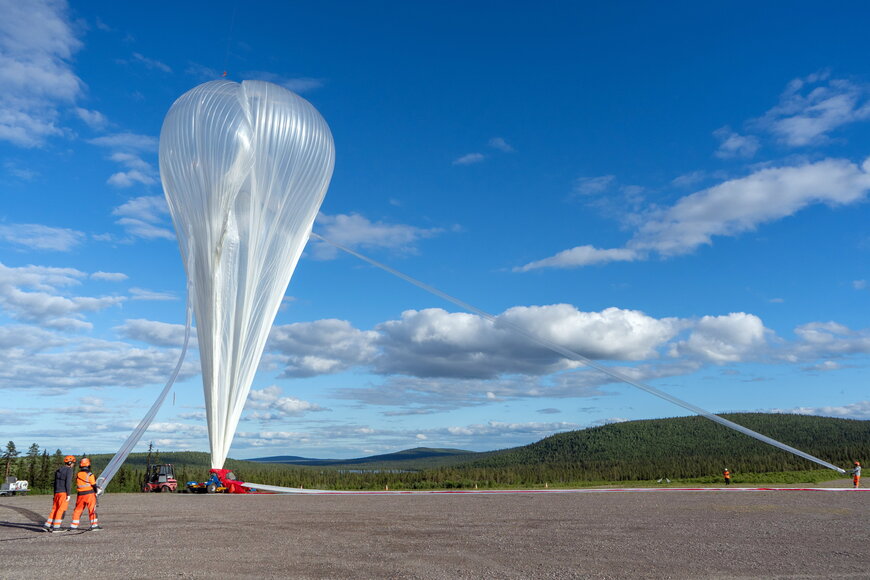
Safran Electronics & Defense and Hemeria have signed a memorandum of understanding to co-develop electromagnetic intelligence and electronic warfare solutions operated from the stratosphere. This technical cooperation integrates specialized sensors and automated data-fusion software into high-altitude balloon platforms to optimize the detection, identification, and analysis of land, air, and maritime radars and communications.
Operational Context and Strategic Alignment
Operating at very high altitudes establishes an unobstructed line of sight, mitigating earth-curvature limitations and terrain masking that restrict terrestrial or low-altitude airborne sensors. This positioning enables continuous, long-range observation over contested environments. Hemeria provides the specialized stratospheric balloon platform, ensuring persistent aerial coverage. Safran Electronics & Defense, through its subsidiary Safran.AI, integrates advanced sensor systems and automated data-fusion capabilities to process multi-source electromagnetic emissions directly on the platform.
Technical Architecture and Intelligence Systems
The system architecture combines Hemeria's structural and flight control engineering with Safran.AI's processing algorithms. The primary technical challenge lies in managing and interpreting large volumes of signal data in real time.
To address this, the digital infrastructure uses localized artificial intelligence models to execute multi-sensor data fusion. Instead of transmitting raw spectral data to ground stations—which requires high bandwidth and risks signal interception—the onboard processing unit filters, cross-references, and characterizes electromagnetic signatures locally. The system relies on trained machine learning models to identify anomalies, classify transmitter types, and automate threat detection within the radio frequency spectrum.
Capabilities and System Implementation
The deployment of these automated analysis systems addresses critical technical requirements in modern electronic warfare, specifically accelerating the decision cycle through high-speed information dominance.
- Signal Characterization: Automated classification of complex radar modulations and communication protocols.
- Geolocalization accuracy: Cross-referencing multi-source sensor inputs to precisely map the coordinates of emitting sources.
- System Resilience: Operating above standard air defense systems while maintaining data transmission links under electronic countermeasure conditions.
Integrating these technologies allows armed forces to establish faster operational awareness. By combining the physical endurance of persistent stratospheric platforms with algorithmic data processing, the solution ensures actionable intelligence in dense, contested electromagnetic environments.
Edited by Evgeny Churilov, Induportals Media - Adapted by AI.
www.safran-group.com
Edited by Evgeny Churilov, Induportals Media - Adapted by AI.
www.safran-group.com
