
www.aero-defence.tech
17
'26
Written on Modified on
Integrating Guided Interceptor Missiles into Unmanned Ground Platforms
Milrem Robotics and Frankenburg Technologies cooperate to develop automated mobile short-range air defense capabilities using cost-effective precision interceptors.
milremrobotics.com
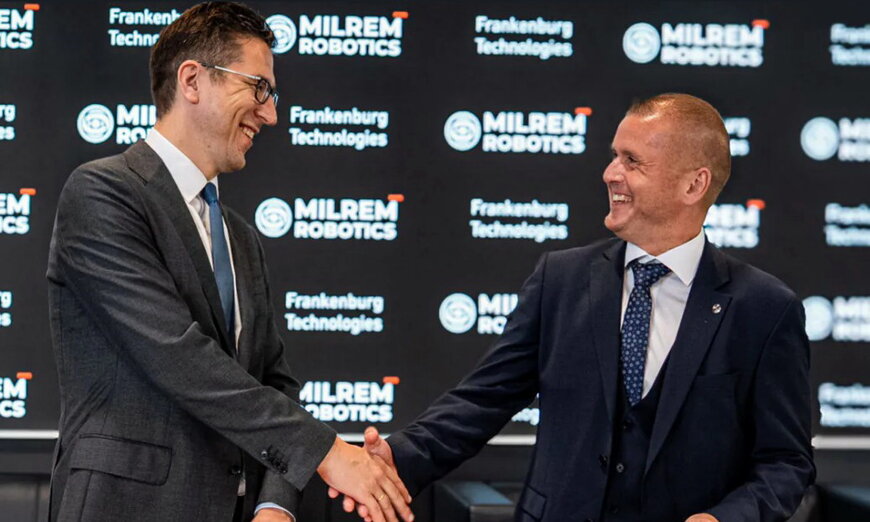
Milrem Robotics and Frankenburg Technologies have entered a cooperation agreement to develop next-generation unmanned counter-uncrewed aerial systems capabilities. The joint effort focuses on integrating precision-guided interceptor missiles into mobile autonomous ground platforms to protect digital infrastructure and military installations against large-scale drone threats.
Industrial Challenge and Strategic Cooperation
Modern defense operations face an increasing proliferation of low-cost aerial drones, creating an urgent requirement for scalable counter-uncrewed aerial systems. Conventional air defense assets rely on highly complex, expensive missiles that are economically unsustainable for countering mass drone deployments. To address this operational challenge, Frankenburg Technologies and Milrem Robotics are combining their respective expertise in missile technology and industrial automation to develop a distributed short-range air defense solution.
Technical Solution and System Integration
The technical solution integrates Frankenburg Technologies' Mark I missile onto Milrem Robotics' unmanned ground vehicles. The Mark I is a compact, precision-guided interceptor engineered specifically for mass manufacturing using commercially available components. This design approach reduces short-range intercept costs by more than 10 times compared to existing conventional missile systems.
Milrem Robotics provides the modular autonomous ground platform, which serves as the mobile hosting infrastructure for the missile payload. The integrated architecture allows the unmanned vehicle to autonomously reposition and rapidly engage aerial threats. By utilizing open interfaces and a modular system design, the combined platform provides adaptable short-range air defense coverage without exposing personnel to direct operational risks.
Deployment and Joint Testing Phases
The memorandum of understanding signed at the Eurosatory trade show in June 2026 establishes a structured framework for engineering integration and validation. The companies are allocating technical responsibilities to achieve a joint system demonstration within approximately twelve months.
Initial phases focus on mechanical and electronic interface alignment between the missile launcher and the robotic chassis. Following initial integration, the companies will conduct joint trials and operational demonstrations. The cooperative framework also covers long-term industrialization pathways, including the localization of production capabilities and technical support infrastructure for defense and security customers.
Operational Applications and Benefits
The primary application areas for this mobile technical solution include the protection of critical national digital infrastructure, industrial automation hubs, and forward military positions. By pairing cost-effective effectors with mobile robotic platforms, the system achieves process stability in defense operations through continuous area monitoring and rapid threat mitigation. The main operational benefits include enhanced force protection, sustained low-cost intercept capabilities, and significantly reduced human risk achieved via remote, automated deployment in high-threat environments.
Edited by Evgeny Churilov, Induportals Media - Adapted by AI.
www.milremrobotics.com
