
www.aero-defence.tech
09
'26
Written on Modified on
Autonomous Medium-Lift Rotary Platforms for Multi-Mission Operations
Uncrewed conversion methodologies and integrated artificial intelligence systems from Airbus Helicopters optimize payload capacity and independent flight operations within autonomous aerial ecosystems.
www.airbus.com
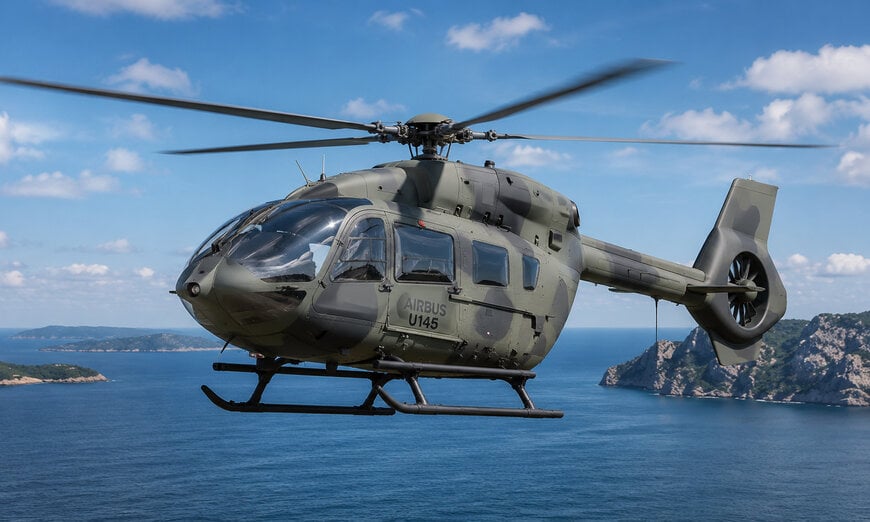
Airbus Helicopters introduced the U145, an uncrewed configuration of its twin-engine light utility helicopter, during the ILA Berlin airshow. The development integrates autonomous flight guidance systems and heavy-cargo adaptations into a proven multi-role airframe to establish a mission-agnostic uncrewed aerial system for civil and defense sectors, with a maiden flight planned for the end of 2026 and an entry into service slated for the next decade.
Airbus Helicopters Platform Conversion Frameworks
The company leverages established engineering frameworks from its crewed rotary portfolio to transition existing configurations into autonomous platforms. The development of the U145 follows the engineering methodology applied to the VSR700 uncrewed aerial system, which was derived from the Cabri G2 light helicopter. To maximize volumetric utility and internal load efficiency, the U145 introduces extensive structural alterations to the standard H145 fuselage profile. The complete removal of the physical cockpit infrastructure allows for the installation of an integrated nose door assembly featuring a foldable loading table, complemented by a structurally reinforced, dedicated cargo cabin floor.
Autonomous Guidance Topologies and Mission Orchestration
Autonomous mission orchestration across complex airspace environments requires high-fidelity sensor integration and real-time processing capabilities. The U145 utilizes a specialized onboard sensor suite interfaced with artificial intelligence architectures to facilitate full flight autonomy. To scale operational capabilities within the European defense sector, development is conducted alongside autonomous mission partners to expand the broader uncrewed aerial system ecosystem. For high-threat military applications, including drone mothership functionality for air-launched effects, the platform incorporates modular payloads developed in partnership with MBDA, supporting crewed-uncrewed teaming operations, armed scouting, surveillance, firefighting, and disaster management.
Transatlantic Engineering Partnerships and Fleet Metrics
In the United States marketplace, Airbus U.S. Space & Defense is collaborating with Shield AI, L3Harris, and Parry Labs to develop the MQ-72C for the United States Marine Corps. This specialized variant is a fully autonomous iteration of the UH-72B Lakota, incorporating tailored electronic systems and a digital backbone to meet specific tactical logistics requirements.
Globally, the foundational H145 aircraft family maintains an operational footprint exceeding 1,800 units across civil, parapublic, and military sectors, with a cumulative operational history of more than 8.5 million flight hours. Propulsion is sustained by twin Safran Arriel 2E turboshaft engines regulated by a full authority digital engine control system. This configuration minimizes carbon dioxide output and provides a low acoustic footprint, making it the quietest rotary platform within its performance category.
Additional Context: Technical Specifications and Competitive Benchmarking
The deployment parameters and structural specifications of the U145 establish distinct capacity and performance variations when evaluated against alternative uncrewed vertical takeoff and landing systems and traditional crewed platforms within the medium-lift aviation sector.
The U145 features a Maximum Take-Off Weight of 3,800 kg, positioning it as a highly agile, twin-engine uncrewed cargo solution. This contrasts with heavier, specialized uncrewed logistics platforms like the Kaman K-MAX TITAN, which features a higher maximum take-off weight of 5,443 kg but relies on a single-engine configuration and intermeshing rotor mechanics optimized almost exclusively for external slung loads. The U145 differentiates itself by utilizing its twin-engine reliability and dual-FADEC control framework to support high-altitude operations and multi-mission versatility within internal cabin layouts.
Furthermore, while alternative retrofitted autonomous systems retain the original cockpit footprint to allow optional piloting, the U145 architectural conversion permanently replaces the cockpit with a forward-facing cargo door and foldable loading table. This design change maximizes usable interior volume for high-volume supply distribution while eliminating the weight penalties associated with crew-support structures. Compared to competitive twin-engine utility platforms like the Bell 412 series, which operates with a maximum gross weight near 5,400 kg in standard configurations, the U145 architecture minimizes overall empty weight and mechanical complexity by transitioning to an uncrewed model, using its 3,800 kg maximum weight class to reduce logistical footprints and fuel consumption during automated multi-mission cycles.
Edited by Sucithra Mani, Induportals editor – adapted by AI.
www.airbus.com
