
www.aero-defence.tech
04
'26
Written on Modified on
Integration of Mobile Robotics in Commercial Aircraft Assembly
Airbus Robotics has developed and industrialised an in-house mobile robotic system to automate interior cabin installation processes.
www.airbus.com
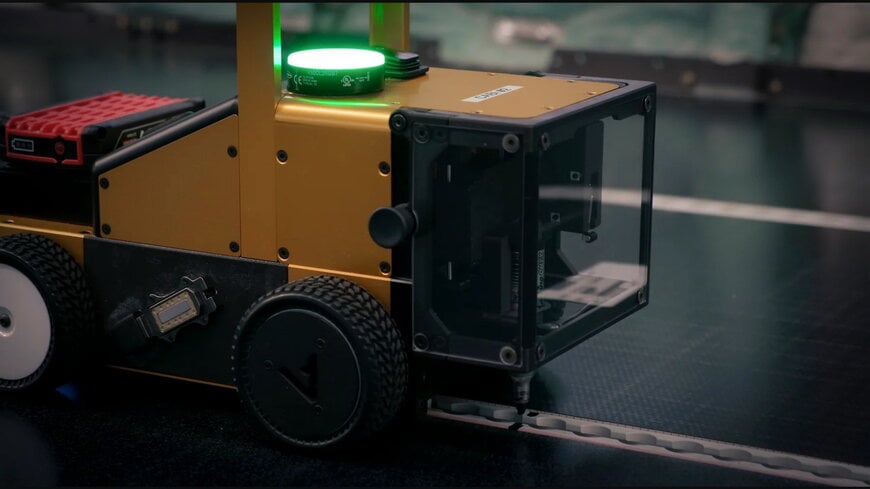
Airbus Robotics has introduced CabinMarker, a lightweight automated system designed to streamline seat-positioning tasks within commercial aircraft fuselages. This technology addresses the ergonomic and throughput challenges faced by the aerospace manufacturing sector during production rate increases.
Production Automation and Ergonomic Optimization in Aerospace Manufacturing
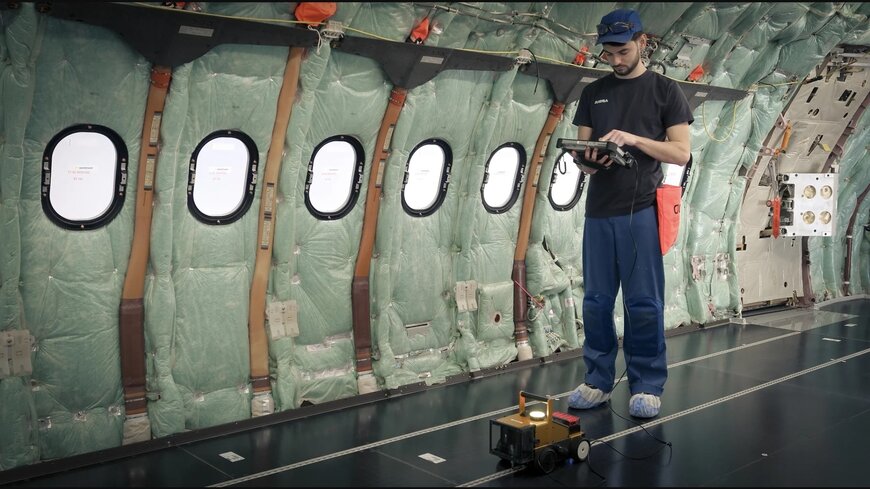
Aerospace manufacturers face critical requirements to accelerate production rates while maintaining stringent quality control and safety standards. Traditional aircraft cabin installation relies heavily on manual labor for repetitive, low-clearance tasks. Operators routinely spend extended periods kneeling or crawling to measure and mark seat track positions on aircraft floors, leading to physical strain and variable processing times.
By transitioning from commercially available static robotic arms to specialized, internally developed mobile units, the manufacturing framework shifts heavy physical workloads to automated systems. This transition allows skilled operators to reallocate engineering hours to complex assembly tasks that require human precision, thereby supporting the broader industrial ramp-up.
Technical Specifications and Operational Efficiency of CabinMarker
The CabinMarker system is a mobile automated platform developed internally by Airbus Robotics, featuring a low-mass design of exactly four kilograms. The technology originated as a prototype in 2018 and achieved formal industrial certification in December 2025 following compliance validation for production environments.
The system automates the precise marking and positioning phases of seat installation. Functionally, the robot executes floor tracking operations with high precision, which minimizes manual alignment deviations and subsequent rework.
In terms of operational efficiency, the automated unit completes a standard cabin marking cycle in just 30 minutes, whereas manual processing by a human operator requires 150 minutes. This drastic reduction represents an 80% decrease in total processing time for this specific assembly stage. Furthermore, the system requires a minimal deployment team, optimizing human resource allocation across the assembly line.
Deployment Timeline and Scalability Across Final Assembly Lines
The development timeline of the technology progressed from its initial prototype phase in 2018 to official industrial certification in December 2025. Following this validation, the first operational deployment is scheduled for late 2026 at the Jean-Luc Lagardère A321 final assembly line in Toulouse, France, focusing specifically on the A321XLR variant. The deployment strategy involves allocating two units per final assembly line based on the intermittent nature of seat-fitting schedules.
Future scaling plans involve moving into a new phase for wide-body aircraft, specifically the A330 final assembly line, where preliminary testing has already been successfully completed. Because the initial physical architecture of the robot is optimized for single-aisle aircraft geometries, expanding the deployment to wide-body platforms or manufacturing facilities in Germany, China, Canada, and the United States will require structural modifications to the chassis and navigation parameters.
The underlying mobile hardware is designed as a multipurpose platform. Technical iterations under development include substituting the primary marking tool with an optical camera assembly for automated corrosion inspection. Additionally, integrating a vacuum module and tape-dispensing mechanism will allow the platform to automate the cleaning and masking of aircraft floor rails.
Additional Context: Technical Specifications and Competitive Benchmarking
The deployment of lightweight, task-specific mobile robots represents a distinct shift from legacy aerospace automation, which historically relied on heavy, multi-ton Cartesian or six-axis gantry systems for drilling and riveting.
In the broader automated guided vehicle and mobile robotics market, comparable platforms generally utilize standard differential drive systems combined with Light Detection and Ranging for localization. However, standard commercial mobile robots typically lack the ultra-low clearance profile required to navigate the tightly confined joist and rail structures of an open aircraft cabin floor before seat installation.
While heavy automation systems from suppliers like Kuka or Electroimpact deliver high rigidity for structural drilling, they cannot be deployed inside an almost completed cabin. The four-kilogram mass of this system allows for manual deployment by a single operator without auxiliary hoisting equipment, complying with standard occupational health and safety limits for lifting. Compared to standard industrial mobile platforms that often weigh between 25 and 100 kilograms, this platform minimizes the structural load placed on unreinforced cabin floor panels during the assembly phase.
Edited by Evgeny Churilov, Induportals Media - Adapted by AI.
www.airbus.com
