
www.aero-defence.tech
27
'26
Written on Modified on
Hybrid-Electric eVTOL Certification for Heavy Cargo
AutoFlight advances hybrid-electric eVTOL certification following multi-aircraft coordination testing, targeting regulated low-altitude logistics, emergency response, and regional cargo transport.
www.autoflight.com
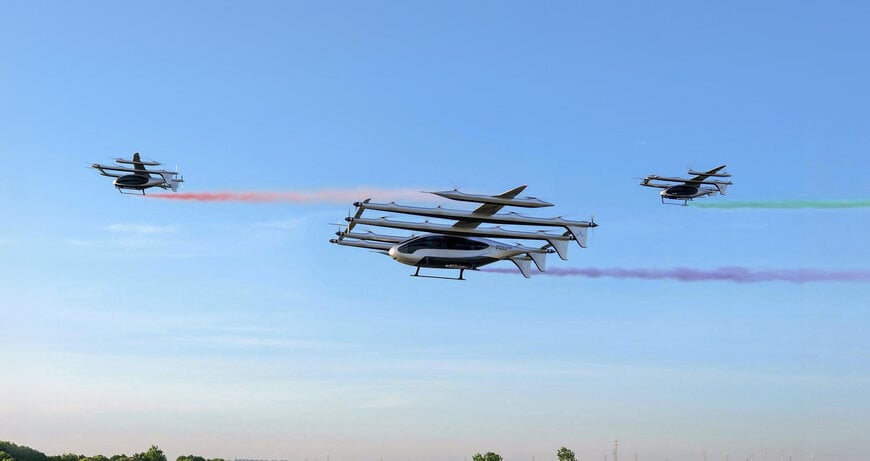
AutoFlight has completed a mixed-fleet formation flight involving one V5000 Matrix and two V2000-series eVTOL aircraft, while moving its V5000CGH cargo aircraft into airworthiness certification. The development is relevant to cargo aviation and advanced air mobility because it addresses two operational barriers simultaneously: coordinated fleet management and the payload-range limitations that have constrained cargo eVTOL deployment.
Multi-Aircraft Coordination in Low-Altitude Logistics
The formation test involved aircraft in both the 5-ton and 2-ton categories, validating communication links, route planning, coordinated flight execution, and safety control between dissimilar platforms. For low-altitude logistics networks, this matters because commercial deployment will depend not only on individual aircraft certification but also on the ability to manage multiple aircraft operating within shared airspace.
Mixed-fleet interoperability is particularly relevant for digital supply chain applications where aircraft with different payload classes may be assigned dynamically according to cargo urgency, mission distance, or infrastructure availability. In emergency logistics, for example, smaller aircraft may transport medical supplies into constrained landing zones while larger platforms move heavier equipment between regional hubs.
The demonstration also suggests AutoFlight is developing beyond a single-aircraft operational model toward fleet orchestration, an area that remains technically challenging due to requirements for communication redundancy, collision avoidance, route deconfliction, and regulatory oversight.
Heavy-Payload Hybrid-Electric Aircraft Architecture
The V5000 Matrix serves as AutoFlight’s larger cargo platform, with the V5000CGH representing its hybrid-electric cargo configuration.
According to the company, the aircraft specifications include a maximum take-off weight of 5,700 kg, a payload capacity of 1.5 metric tons, and a 14 m3 cargo compartment sized for two AKE-standard air cargo containers. Cruise speed is specified at 280 km/h, with a maximum range of 1,500 km.
These figures position the aircraft differently from many shorter-range battery-electric eVTOL designs, which typically prioritize urban transport or lighter cargo missions. Hybrid-electric propulsion is relevant here because purely battery-electric architectures remain constrained by energy density when payload and range requirements increase simultaneously.
By combining vertical take-off capability with extended cruise endurance, the platform is intended to bridge operational gaps between helicopter logistics and conventional regional cargo aviation.
Target Applications Beyond Urban Air Mobility
The application profile extends beyond urban short-haul transport.
In emergency response scenarios, the aircraft could support transport of rescue equipment, medical supplies, and disaster-response cargo where road access is compromised. Offshore energy logistics represent another use case, particularly for time-sensitive delivery to maritime platforms where vessel-based replenishment introduces longer transit times.
Regional feeder freight is another intended segment. With a stated 1,500 km range, the aircraft is positioned for medium- to long-distance cargo movement between regional nodes, potentially enabling interprovincial logistics operations without dependence on conventional runway infrastructure.
This shifts the operational discussion from urban air taxi concepts toward broader cargo aviation infrastructure.
Airworthiness Certification Strategy
AutoFlight stated that the V5000CGH has entered formal airworthiness certification following its transition flight in February 2026.
Certification progression is significant because many advanced air mobility programmes remain in prototype or demonstration phases. Moving into certification indicates a transition from engineering validation toward regulatory compliance, requiring documented conformity in flight performance, safety systems, structural integrity, propulsion reliability, and operational procedures.
The company stated that its certification team includes personnel with prior programme experience involving the ARJ21-700, C919, and Diamond DA42.
AutoFlight also noted that its V2000CG CarryAll has already received CAAC Type Certificate (TC), Production Certificate (PC), and Airworthiness Certificate (AC), while its six-seat V2000EM Prosperity passenger aircraft has entered compliance verification.
This provides a regulatory baseline that may support certification process maturity, although certification pathways for larger hybrid-electric aircraft remain technically demanding.
Infrastructure Implications for Advanced Cargo Aviation
A recurring limitation in cargo eVTOL deployment has been the trade-off between payload, range, and operating economics.
Smaller aircraft may offer operational flexibility but struggle with commercially relevant freight volumes. Larger conventional aircraft provide capacity but require airport infrastructure and longer turnaround cycles.
AutoFlight’s announced specifications suggest an attempt to address this gap through hybrid-electric propulsion and larger airframe design. If certification progresses successfully, such aircraft could support decentralized cargo routing models where vertical take-off operations reduce dependency on established airport networks.
The commercial viability, however, will depend on operational cost per tonne-kilometre, maintenance complexity, infrastructure integration, and regulatory approval for coordinated low-altitude fleet operations.
Additional Context
This section details technical specifications and competitive benchmarking not included in the original news release.
Cargo-focused advanced air mobility remains an emerging segment with relatively few directly comparable platforms.
Elroy Air’s Chaparral hybrid-electric cargo VTOL, for example, targets middle-mile logistics with a payload range of approximately 136–227 kg and maximum range of about 644 km, placing it in a substantially lighter operational category than the V5000CGH.
BETA Technologies’ ALIA platform addresses utility and cargo transport, but published configurations emphasize lower cargo volume and shorter demonstrated operational range relative to AutoFlight’s announced heavy-lift specifications.
If AutoFlight’s published 1.5-ton payload and 1,500 km range are validated through certification, the V5000CGH would occupy a less crowded segment focused on heavier regional cargo transport rather than last-mile or light middle-mile logistics. The technical differentiator would therefore be less about vertical flight alone and more about scaling hybrid-electric architecture into commercially relevant freight capacity.
Edited by Aishwarya Mambet, Induportals Editor, with AI assistance.
www.autoflight.com
