
www.aero-defence.tech
21
'26
Written on Modified on
Airbus Helicopters and Spanish Navy Complete Uncrewed System Flights
The successful integration of crewed helicopters and uncrewed aerial systems with naval vessels validates a real-time operational link to extend multi-domain maritime combat range.
www.airbus.com
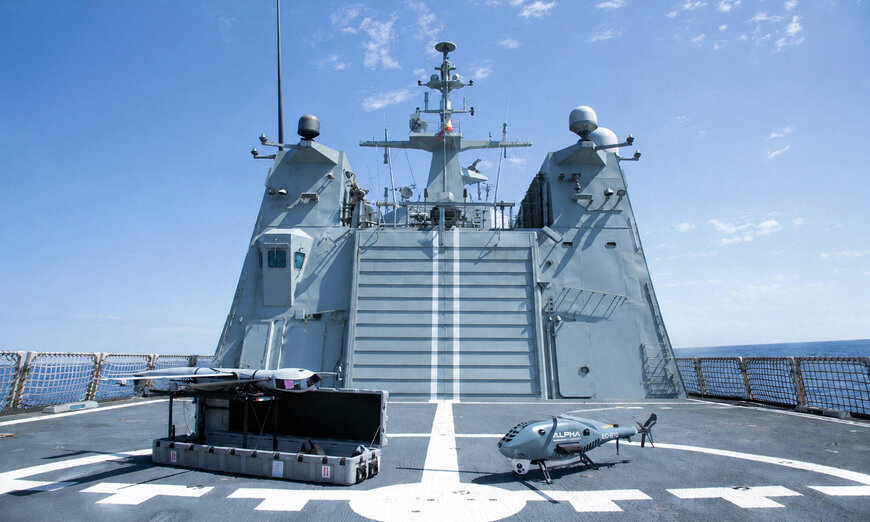
Airbus Helicopters cooperated with Navantia and Alpha Unmanned Systems to validate a multi-domain operational link during tactical flight trials for the Spanish Navy. The trial established real-time data transmission between uncrewed aerial systems, a crewed helicopter, and an offshore patrol vessel to extend maritime reconnaissance capabilities.
Multi-Domain Operational Architecture and System Roles
The technical challenge addressed by this cooperation involves the seamless integration of disparate uncrewed aerial systems (UAS) with existing naval combat infrastructure. Airbus Helicopters provided the primary command interface and the H135 helicopter utilized during the trial. Alpha Unmanned Systems supplied the A900 rotary-wing UAS, while Airbus deployed the Flexrotor fixed-wing tactical UAS. Navantia provided the overarching tactical integration software. This cooperative framework was required to resolve the interoperability challenges of managing multiple uncrewed platforms from an airborne asset while simultaneously streaming telemetry and sensor data to a surface vessel.
Tactical Solution and System Integration
The technical architecture relies on the HTeaming tablet, a modular crewed-uncrewed teaming solution developed by Airbus Helicopters. This hardware and software interface allows an airborne helicopter pilot to control uncrewed platforms during flight. During the operation, the HTeaming platform proved system-agnostic by successfully managing both the Flexrotor and the third-party Alpha 900 UAS.
Sensor payloads from the UAS captured real-time imagery during a simulated high-speed boat chase. This data was routed through the Helicopter Integrated Tactical System (HITS), an airborne tactical console that serves as a communication bridge to the vessel.
Implementation and Infrastructure Deployment
The deployment took place on the offshore patrol vessel Rayo in Rota, Spain. Both uncrewed platforms executed autonomous take-offs and landings from the flight deck of the moving naval vessel.
The data transmitted from the airborne assets was integrated directly into Navantia’s Naval Advanced Integrated Autonomous Vehicles Defence system (NAIAD). NAIAD acts as the tactical integration layer for unmanned assets, formatting and feeding the sensor data into SCOMBA, the standard combat management system used across the Spanish Navy fleet. This link allows the vessel to populate its combat station with reconnaissance data from areas situated beyond the line-of-sight range of its native radar and optical sensors.
Operational Impact and Future Development
The trial demonstrated a stable intelligence, surveillance, target acquisition, and reconnaissance (ISTAR) link. By offloading sensor placement to uncrewed systems, the surface vessel acquires real-time targeting and tracking data without exposing crewed assets to potential threats.
The successful validation of the HTeaming tablet and the NAIAD/SCOMBA interface establishes a baseline for future operational deployments. Future development phases are scheduled to expand this architecture to accommodate drone swarm technologies and further standardize the data interfaces between aerial, surface, and land-based defense assets.
Edited by Evgeny Churilov, Induportals Media - Adapted by AI.
www.airbus.com
