
www.aero-defence.tech
12
'26
Written on Modified on
Multipurpose spaceplane proposal for European space missions
Dassault Aviation and OHB partner on the VORTEX-S proposal for ESA to develop a multipurpose spaceplane for station transport and autonomous orbital missions.
www.dassault-aviation.com
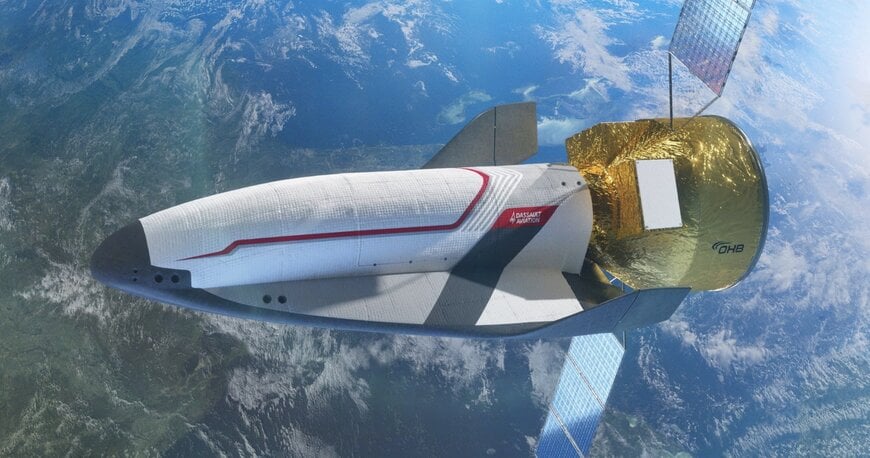
Dassault Aviation and OHB have formed a consortium to propose the VORTEX-S multipurpose spaceplane to the European Space Agency (ESA), aiming to secure sovereign orbital transport capabilities.
Technical architecture and modular orbital integration
The VORTEX-S is engineered as a reusable spaceplane capable of dual-mode operations: round-trip transportation to space stations and autonomous orbital free-flyer missions. The technical architecture is divided between two primary leads to ensure a highly integrated system within the digital supply chain of European aerospace. Dassault Aviation serves as the prime architect and global integrator of the spaceplane itself, utilizing its expertise in atmospheric flight and reentry aerodynamics. OHB acts as the architect and integrator of the service module, providing the necessary propulsion, power, and life support systems required for sustained orbital flight.
Enhancing European space mobility and autonomy
The proposal addresses a critical gap in Europe’s current space infrastructure by providing a dedicated platform for space mobility. The VORTEX-S is designed to advance autonomous European space transportation, reducing reliance on non-European launch and reentry services. This initiative is characterized by:
- Multipurpose Capability: Supporting both crew/cargo logistics and specialized scientific missions in low Earth orbit (LEO).
- Consortium Expansion: Ongoing discussions with major European space companies to integrate specialized subsystems and technologies.
- Strategic Synergy: The collaboration pairs aircraft manufacturing precision with satellite and orbital module expertise, a combination essential for the complex transition between vacuum and atmospheric environments.
Operational vision for reusable orbital systems
The VORTEX-S aims to establish a highly effective and repeatable mission profile. By utilizing a reusable airframe, the project seeks to lower the total cost of ownership for orbital access while maintaining high reliability standards. The partnership between these high-tech entities is intended to provide ESA with a robust, sovereign solution for orbital maintenance, research, and logistics, ensuring that the automotive data ecosystem and broader industrial sectors can benefit from European-led space-based research and telecommunications infrastructure.
Additional Context
This section details technical specifications and competitive benchmarking not included in the original product announcement.
The VORTEX-S enters a competitive landscape currently dominated by the Sierra Space Dream Chaser and the Boeing X-37B. While specific payload capacities for VORTEX-S remain classified, benchmarking it against ESA’s previous "Space Rider" program suggests a focus on a more versatile, higher-mass-return capability. Technically, the VORTEX-S must solve the "transonic pitch-up" challenge common in lifting-body designs during reentry; by leveraging Dassault’s flight control algorithms from the Falcon and Rafale programs, the system likely targets a cross-range capability exceeding 1,500 km. Compared to the Dream Chaser, which uses a non-toxic hypergolic propellant system, the VORTEX-S/OHB service module is expected to align with ESA’s "Clean Space" initiative, potentially utilizing liquid oxygen and methane (methalox) or high-performance green monopropellants to ensure sustainability in the digital supply chain of future orbital logistics.
Edited by Romila DSilva, Induportals editor – adapted by AI.
The VORTEX-S aims to establish a highly effective and repeatable mission profile. By utilizing a reusable airframe, the project seeks to lower the total cost of ownership for orbital access while maintaining high reliability standards. The partnership between these high-tech entities is intended to provide ESA with a robust, sovereign solution for orbital maintenance, research, and logistics, ensuring that the automotive data ecosystem and broader industrial sectors can benefit from European-led space-based research and telecommunications infrastructure.
Additional Context
This section details technical specifications and competitive benchmarking not included in the original product announcement.
The VORTEX-S enters a competitive landscape currently dominated by the Sierra Space Dream Chaser and the Boeing X-37B. While specific payload capacities for VORTEX-S remain classified, benchmarking it against ESA’s previous "Space Rider" program suggests a focus on a more versatile, higher-mass-return capability. Technically, the VORTEX-S must solve the "transonic pitch-up" challenge common in lifting-body designs during reentry; by leveraging Dassault’s flight control algorithms from the Falcon and Rafale programs, the system likely targets a cross-range capability exceeding 1,500 km. Compared to the Dream Chaser, which uses a non-toxic hypergolic propellant system, the VORTEX-S/OHB service module is expected to align with ESA’s "Clean Space" initiative, potentially utilizing liquid oxygen and methane (methalox) or high-performance green monopropellants to ensure sustainability in the digital supply chain of future orbital logistics.
Edited by Romila DSilva, Induportals editor – adapted by AI.
