
www.aero-defence.tech
29
'26
Written on Modified on
Modular Uncrewed Ground Vehicle for Littoral Operations
Textron Systems introduces scalable robotic platform for U.S. Marine Corps mobility and uncrewed teaming missions.
www.textron.com
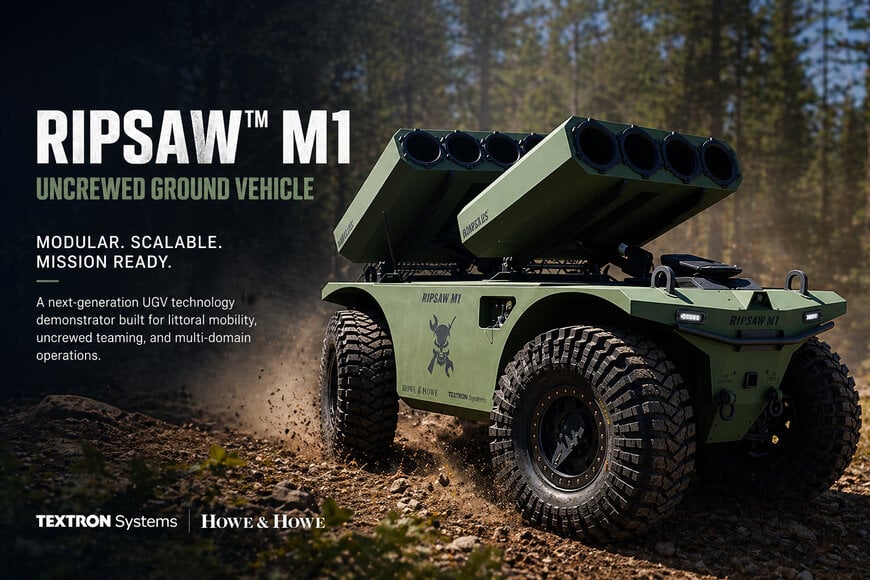
Textron Systems Corporation, in collaboration with Howe & Howe Inc., presented a new uncrewed ground vehicle (UGV) technology demonstrator designed for littoral mobility, reconnaissance, and autonomous combat support in expeditionary environments.
Demonstration Context and Operational Role
The vehicle was introduced at the Modern Day Marine Exposition 2026, held in Washington, D.C. on April 28, 2026. The platform is developed to support operational concepts aligned with the U.S. Marine Corps’ Force Design 2030, particularly in distributed maritime operations and contested littoral zones.
The system is positioned as a robotic extension to existing platforms such as the Advanced Reconnaissance Vehicle (ARV) and Amphibious Combat Vehicle (ACV), enabling manned–unmanned teaming and reducing direct exposure of personnel in high-risk missions.
Modular Open Systems Approach and Scalability
The demonstrator is based on a Modular Open Systems Approach (MOSA), a design framework widely adopted in defense systems to ensure interoperability, upgradeability, and vendor-agnostic integration. This architecture allows the platform to scale size, weight, power, and payload (SWaP) configurations depending on mission requirements while maintaining a common robotic control core.
Such modularity supports integration into a broader digital supply chain, enabling faster upgrades and compatibility with evolving sensor, autonomy, and weapon subsystems. The standardized architecture also aligns with U.S. Department of Defense requirements for open-system interoperability.
Mission Capabilities and Payload Integration
The UGV is designed to support multiple mission profiles, including reconnaissance, surveillance, and target acquisition (RSTA), as well as counter-unmanned aircraft system (C-UAS) operations. Its payload flexibility allows integration of hard-kill counter-UAS systems, enabling kinetic interception of aerial threats.
Additionally, the platform can function as a launch system for loitering munitions, extending operational reach without requiring direct deployment of manned assets. These capabilities position the vehicle as a force multiplier in distributed operations, where rapid deployment and adaptability are critical.
Mobility and Battlefield Functionality
The tracked configuration of the platform is optimized for high-mobility operations across varied terrains, including coastal and amphibious environments. Its compact and transportable design supports deployment from multiple platforms, including amphibious vehicles and naval assets.
By offloading high-risk tasks such as forward reconnaissance or threat engagement, the system contributes to preserving higher-value crewed vehicles and reducing operational risk. The emphasis on transportability and agility aligns with expeditionary warfare requirements, where rapid repositioning and logistical efficiency are essential.
Autonomous Systems Integration
The platform leverages experience from multi-domain autonomous systems development, integrating land-based robotics with operational principles derived from air and maritime uncrewed systems. This cross-domain approach supports consistent control architectures and data exchange frameworks, contributing to a broader automotive data ecosystem within military robotics.
The use of a common robotic core across vehicle variants enables unified command-and-control interfaces, reducing operator training complexity and facilitating coordinated autonomous operations.
Industry Context and Comparative Positioning
Within the defence robotics sector, modular UGV platforms are increasingly evaluated based on interoperability, payload flexibility, and autonomy integration. Comparable systems from other manufacturers also adopt MOSA principles; however, differentiation typically lies in scalability of SWaP configurations and integration with existing combat vehicle ecosystems.
The presented system emphasizes compatibility with Marine Corps-specific platforms and doctrines, particularly in littoral and expeditionary operations, where integration with amphibious systems is a key requirement.
Development Background
Howe & Howe Inc. contributes expertise in rugged robotic land systems designed for extreme environments, while Textron Systems brings multi-domain uncrewed systems experience across air, land, and maritime applications. The combined development approach reflects a trend toward integrated defence platforms that operate within unified operational architectures.
Conclusion
The demonstrated uncrewed ground vehicle highlights ongoing advancements in modular defence robotics, with a focus on scalability, interoperability, and mission adaptability. By combining MOSA architecture with multi-role payload capability, the platform addresses evolving operational requirements for distributed, autonomous, and risk-reduced ground operations.
Edited by an industrial journalist Sucithra Mani with AI assistance
www.textron.com
