
www.aero-defence.tech
01
'26
Written on Modified on
Autonomous attritable UAS for distributed strike operations
Northrop Grumman demonstrates modular uncrewed aircraft for precision strike and ISR during U.S. Army exercise, highlighting autonomous control and extended-range communications.
www.northropgrumman.com
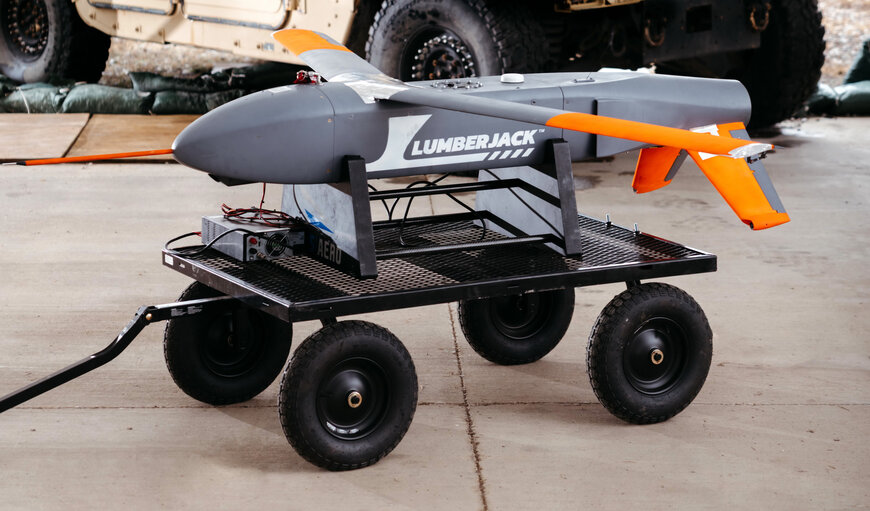
Northrop Grumman presented the operational capabilities of its Lumberjack Group 3 uncrewed aircraft system (UAS) during the U.S. Army’s Operation Lethal Eagle exercise, focusing on autonomous mission execution, modular payload integration, and long-range communications. The system targets distributed strike operations and intelligence, surveillance, and reconnaissance (ISR) missions in contested environments.
Demonstration in a multi-system operational environment
The evaluation took place during Operation Lethal Eagle, conducted by the U.S. Army 101st Airborne Division (Air Assault), where emerging technologies were tested under realistic operational conditions. Within this framework, Lumberjack was assessed as part of a broader ecosystem of interconnected platforms, reflecting current trends in the defense sector toward a distributed combat architecture.
The system was integrated with the U.S. Army’s Maven Smart System, enabling operators to execute missions with a high degree of automation. This setup supports the ongoing development of an autonomous warfare system, where human supervision is maintained while decision-support and execution processes are increasingly delegated to software-driven tools.
Autonomous mission execution and AI-assisted targeting
Lumberjack demonstrated full autonomous mission control, including navigation, targeting, and engagement workflows. AI-supported targeting was enabled through integration with Palantir’s Agentic Effects Agent, which provided automated target detection and adaptive engagement capabilities. This allowed the system to adjust to dynamic battlefield conditions while maintaining a human-in-the-loop control structure.
The platform deployed simulated versions of the Hatchet miniature munition, a six-pound precision-guided payload designed to deliver effects typically associated with larger systems. This reflects a broader shift toward distributed lethality, where smaller, lower-cost platforms deliver targeted effects with reduced logistical burden.
Communications and multi-role functionality
A key technical feature demonstrated during the exercise was beyond line-of-sight (BLOS) communication via satellite datalink. This enabled continuous transmission of mission data, including real-time updates and post-strike damage assessments, supporting command-and-control continuity over extended distances.
Following strike operations, Lumberjack transitioned to ISR mode without reconfiguration, illustrating its multi-role capability. The modular payload bay allows rapid switching between kinetic and non-kinetic mission profiles, supporting a range of operational scenarios from precision engagement to battlefield intelligence collection.
System design and deployment model
Lumberjack is designed as an attritable UAS, meaning it is cost-optimized for expendability in high-risk environments. This design approach reduces cost per effect while enabling sustained operational tempo. The platform incorporates a modular mission kit that converts a third-party airframe into a combat-capable system, allowing for scalable production and flexible deployment.
The system supports both air and ground launch configurations, increasing its adaptability across different mission profiles and operational theaters. Its range and speed enable stand-off deployment, reducing exposure of operators and launch platforms in contested airspace.
Developed in collaboration with Empirical Systems Aerospace (ES Aero) and Palantir, the system progressed from concept to first flight in under 14 months. This development timeline reflects a compressed innovation cycle aligned with current defense procurement priorities, where rapid prototyping and field validation are increasingly emphasized.
Positioning within the evolving UAS landscape
Within the Group 3 UAS category, Lumberjack aligns with a growing class of systems designed for low-cost, high-volume deployment in distributed operations. Compared to traditional high-value platforms, attritable systems prioritize affordability, modularity, and rapid scalability over survivability and reuse.
This positioning corresponds to evolving operational doctrines that emphasize networked, software-defined capabilities and integration into a broader defense digital ecosystem, where interoperability and data exchange are critical performance factors.
Edited by Evgeny Churilov, Induportals Media - Adapted by AI.
www.northropgrumman.com
