
www.aero-defence.tech
27
'26
Written on Modified on
AI-enabled mine countermeasure system for naval operations
Thales introduces a deployable mine countermeasures platform designed to support autonomous naval missions, underwater threat detection and maritime security operations.
www.thalesgroup.com
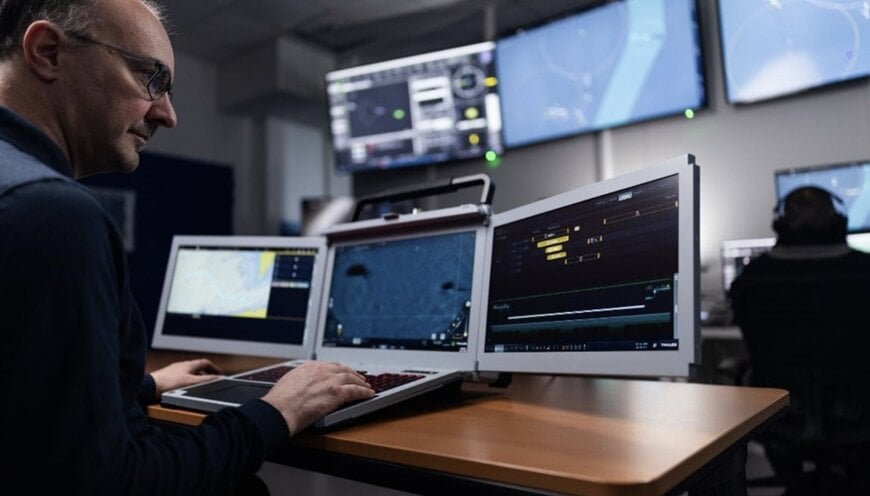
Naval forces are increasingly investing in autonomous and AI-supported mine countermeasure capabilities to secure sea routes and protect offshore infrastructure. In this context, Thales introduced the Expeditionary PathMaster system, a deployable mine countermeasures solution designed for flexible naval operations.
Designed for expeditionary and distributed naval missions
Expeditionary PathMaster is based on a system originally developed for the French Navy (Marine Nationale) and is designed as a scalable and interoperable platform for mine countermeasure missions in coastal and open sea environments.
The system can be operated from multiple deployment points including shore facilities, rigid inflatable boats (RIBs), mine countermeasure vessels, or other naval platforms. This operational flexibility supports expeditionary and amphibious missions where rapid deployment and distributed control are required.
The architecture also allows integration of third-party assets including Autonomous Underwater Vehicles (AUVs), Remotely Operated Vehicles (ROVs), and conventional mine countermeasure vessels within a portable expeditionary operations centre. This interoperability was demonstrated in operational testing with the Lithuanian Navy.
Combining sonar analysis and AI-based mission management
The system incorporates the Mi-Map sonar analysis software, which applies artificial intelligence to accelerate sonar data processing. The system is designed to process sonar datasets up to four times faster than conventional analysis tools while achieving classification accuracy levels of up to 99% for underwater object identification.
Mission coordination is managed through the M-CUBE mission management system, which allows multiple sonar analysis tasks to run simultaneously. The platform provides real-time updates on analysis progress and detected underwater objects, supporting coordinated decision-making during mine countermeasure operations.
These capabilities reflect broader trends toward digital naval operations and autonomous maritime defence systems, where AI is used to reduce analysis time and improve detection reliability.
Mine detection as part of maritime security infrastructure
Mine countermeasures remain a critical naval capability due to risks posed to shipping lanes, ports, and subsea infrastructure such as energy and communications networks.
Thales’ mine warfare systems are designed to support the full operational sequence required in mine countermeasure missions, including detection, classification, localisation, identification, and neutralisation of underwater mines in complex maritime environments.
The Expeditionary PathMaster system extends this capability by combining autonomous platforms, AI-supported sonar interpretation, and portable mission control into a unified operational framework intended to support modern naval force structures.
Supporting autonomous and cyber-secure naval operations
The system is designed to support both crewed and autonomous mine warfare operations while incorporating cybersecurity considerations required for networked naval systems. The use of portable mission control infrastructure also supports rapid deployment scenarios where permanent command infrastructure is unavailable.
Through the integration of autonomous platforms, AI-based sonar analysis, and modular deployment concepts, the system reflects the ongoing shift toward autonomous maritime defence capabilities and digitally coordinated naval operations.
Edited by industrial journalist Aishwarya Mambet, with AI-assistance.
www.thalesgroup.com
