
www.aero-defence.tech
26
'26
Written on Modified on
Additive Manufacturing Strengthens Defence Logistics
Nick Dinges of Replique explains how additive manufacturing enables on-demand production, improving agility, resilience, and supply chain efficiency in defence operations.
replique.io
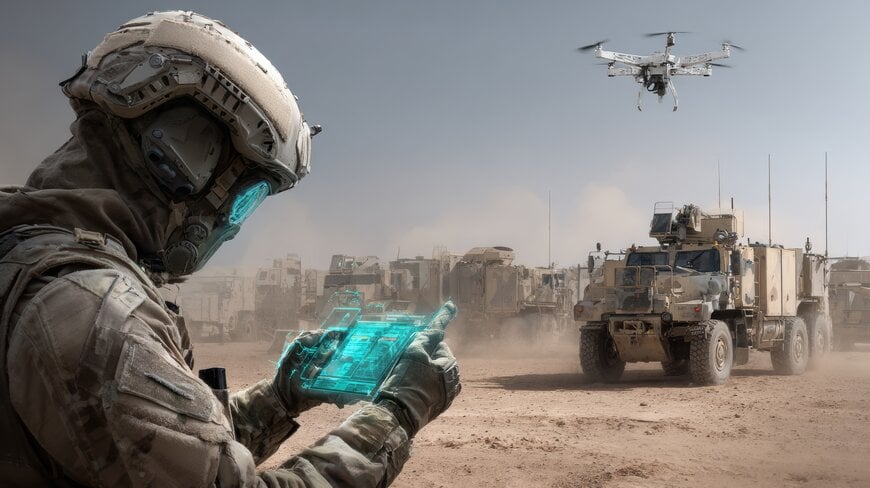
In modern defence environments, where supply chains are increasingly volatile, additive manufacturing (AM) is emerging as a key technology to ensure operational readiness through localised, on-demand production.
Context: Supply chain fragility in defence operations
Defence logistics depends on continuous access to spare parts, tools, and equipment, often sourced globally. Disruptions—whether geopolitical or logistical—can delay deliveries, increase costs, and impact mission readiness.
Traditional manufacturing methods are often not suited to low-volume or urgent production needs, particularly in remote or contested environments.
Additive manufacturing as a logistics enabler
Additive manufacturing enables parts to be produced directly at the point of need using digital design files. This reduces reliance on centralised supply chains and minimises lead times.
Instead of waiting for shipments, operators can manufacture components locally, supporting faster maintenance, repair, and operational continuity. The technology is particularly suited to small-batch or one-off production, where conventional tooling would be inefficient.
Digital inventory and decentralised production
A key advantage of AM lies in digital inventory systems, where qualified part designs are stored securely and accessed when needed. This creates a “virtual warehouse,” allowing defence organisations to produce components on demand while maintaining traceability and data control.
Such decentralised production models reduce the need for physical stockpiles, lowering storage requirements and associated costs.
Applications across defence operations
Additive manufacturing supports a wide range of defence logistics applications:
- Spare parts for vehicles, naval vessels, and aircraft, including brackets, housings, and structural components
- Maintenance tools and fixtures such as jigs, adapters, and alignment tools
- Infrastructure components including enclosures, connectors, and HVAC elements
- Lightweight and ergonomic parts designed to improve usability and reduce load
These applications demonstrate how AM can address both operational and infrastructure-related requirements.
Use cases: Field deployment and legacy systems
Defence organisations are already deploying AM in operational environments. The Royal Netherlands Navy, for example, uses onboard 3D printing to produce spare parts, reducing dependency on supply chains and minimising storage requirements.
AM also enables the reproduction of obsolete components for long-life platforms, where original tooling or suppliers are no longer available. Reverse engineering and digital manufacturing ensure continued availability of critical parts.
Performance and operational benefits
Additive manufacturing allows the production of complex geometries that reduce weight while maintaining strength. This supports improved performance and efficiency in both equipment and logistics.
Compared to traditional methods such as CNC machining or casting, AM requires less infrastructure and can be deployed in more flexible environments.
Conclusion: A strategic tool for resilient operations
As defence organisations face increasing pressure to maintain readiness under uncertain conditions, additive manufacturing provides a scalable and flexible solution. By enabling local production, reducing supply chain dependency, and supporting rapid response, AM is becoming a critical component of modern defence logistics strategies.
Edited by an industrial journalist, Lekshman Ramdas, with AI assistance.
www.replique.com
Use cases: Field deployment and legacy systems
Defence organisations are already deploying AM in operational environments. The Royal Netherlands Navy, for example, uses onboard 3D printing to produce spare parts, reducing dependency on supply chains and minimising storage requirements.
AM also enables the reproduction of obsolete components for long-life platforms, where original tooling or suppliers are no longer available. Reverse engineering and digital manufacturing ensure continued availability of critical parts.
Performance and operational benefits
Additive manufacturing allows the production of complex geometries that reduce weight while maintaining strength. This supports improved performance and efficiency in both equipment and logistics.
Compared to traditional methods such as CNC machining or casting, AM requires less infrastructure and can be deployed in more flexible environments.
Conclusion: A strategic tool for resilient operations
As defence organisations face increasing pressure to maintain readiness under uncertain conditions, additive manufacturing provides a scalable and flexible solution. By enabling local production, reducing supply chain dependency, and supporting rapid response, AM is becoming a critical component of modern defence logistics strategies.
Edited by an industrial journalist, Lekshman Ramdas, with AI assistance.
www.replique.com
