
www.aero-defence.tech
20
'26
Written on Modified on
Open-Architecture Flight Test for AI Mission Autonomy
Northrop Grumman and Shield AI integrate Hivemind software into Talon IQ testbed to validate plug-and-play mission autonomy in airborne systems.
www.northropgrumman.com
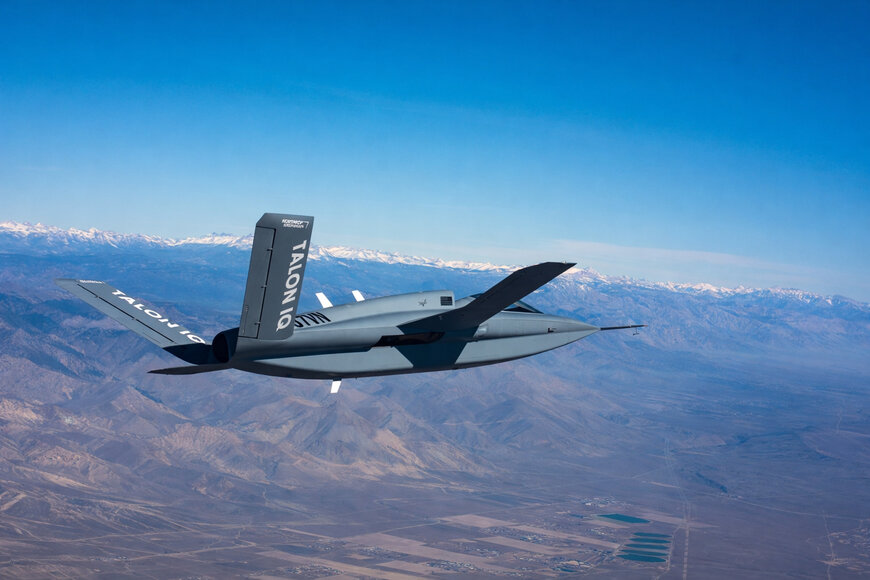
Northrop Grumman and Shield AI have demonstrated the integration of AI-driven mission autonomy software into an open-architecture flight test platform, enabling rapid validation of autonomous capabilities on operational aircraft systems.
Context of the Cooperation
The growing complexity of defense operations requires autonomous systems that can operate reliably in dynamic and contested environments. Conventional development approaches, often based on tightly coupled hardware and software, limit scalability and increase integration time.
To address these constraints, Northrop Grumman, a systems integrator in aerospace and defense, collaborated with Shield AI, a developer of autonomy software. The cooperation focuses on enabling third-party AI solutions to be deployed and tested on a shared flight platform, reducing the need for dedicated airframes and shortening development cycles.
Technical Solution and Responsibilities
The cooperation is built around the Talon IQ testbed, an open-architecture ecosystem based on the Scaled Composites Model 437 aircraft. Northrop Grumman provides the flight platform, system integration, and compliance with Government Reference Architectures (GRAs), ensuring interoperability and secure integration. It also contributes its own Prism mission autonomy software.
Shield AI integrates its Hivemind software, a platform-agnostic autonomy system designed to replicate pilot-level decision-making. Hivemind enables real-time perception, adaptive navigation, and mission execution, including coordination with other systems.
The architecture allows software interchangeability through standardized interfaces. During the flight test, Hivemind controlled the aircraft to perform combat air patrol and target engagement maneuvers before control was seamlessly transferred back to Prism. This demonstrates the ability to switch between autonomy systems without modifying the underlying platform.
Deployment and Implementation
The integration process highlights a shortened development cycle. After a hardware-in-the-loop validation phase, the autonomy software was deployed onto the aircraft and tested in flight. The open architecture enables rapid onboarding of new software modules, while maintaining compatibility with existing avionics and control systems.
This approach reduces the need for platform-specific redesign and allows repeated testing and iteration within the same flight environment.
Applications and Use Cases
The system is intended for defense applications requiring adaptive autonomy, including combat air patrol, target engagement, and coordination between multiple autonomous and crewed systems. It supports scalable deployment across different aircraft types by decoupling software from hardware.
Results and Expected Impact
The demonstration confirms that mission autonomy software can transition from laboratory validation to operational flight within a significantly reduced timeframe. It also validates the use of standardized architectures to integrate third-party AI solutions.
By combining an open test platform with interoperable software, the cooperation establishes a framework for accelerating the deployment of AI-enabled capabilities within defense digital infrastructure, while reducing integration complexity and development costs.
Edited by an industrial journalist Sucithra Mani with AI assistance.
www.northropgrumman.com
