
www.aero-defence.tech
06
'26
Written on Modified on
Multi-Domain Unmanned Systems Integration in Modern Warfare
STM advances integrated unmanned systems architecture connecting air, land, surface and subsurface platforms through a coordinated multi-domain operational framework.
www.stm.com.tr
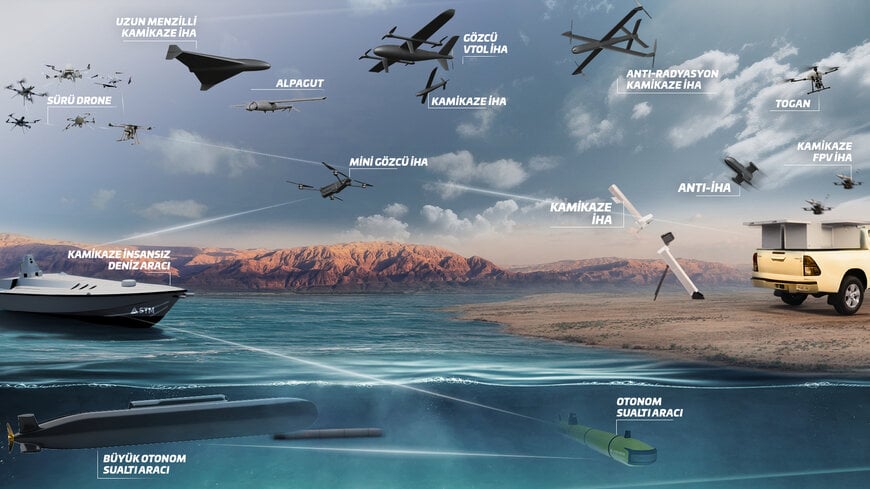
STM, a defence technology company based in Türkiye, is advancing a multi-domain operations architecture designed to integrate unmanned systems across air, land, surface, and underwater environments. The approach combines swarm autonomy, GNSS-independent navigation and unified command-and-control systems to enable coordinated operations in network-enabled battlespaces.
Integrated Multi-Domain Architecture for Unmanned Systems
The increasing complexity of modern conflict environments has driven the development of multi-domain operations (MDO) frameworks that integrate capabilities across multiple operational domains. STM’s Multi-Domain concept addresses this requirement by enabling heterogeneous unmanned systems to operate within a shared operational architecture that supports real-time data exchange, coordinated mission planning and distributed execution.
The system architecture connects multiple unmanned platforms developed by STM, including loitering munitions, reconnaissance UAVs and autonomous underwater vehicles, within a unified command-and-control (C2) framework. These platforms include the KARGU and ALPAGU loitering munition systems, the TOGAN reconnaissance UAV, STM-VTOL UAV, BOYGA ammunition-drop UAV, and the STM NETA autonomous underwater vehicle.
By integrating these platforms within a network-enabled battlespace, the system allows mission data, threat information and task assignments to be shared across platforms operating in different domains.
Autonomy and Swarm Technologies in Contested Environments
Operational environments increasingly involve electronic warfare and degraded satellite navigation. STM addresses these conditions through GNSS-independent navigation capabilities and autonomous mission algorithms.
The swarm UAV architecture enables groups of unmanned platforms to communicate and coordinate tasks dynamically during missions. Through visual navigation systems and autonomous mission management software, swarm elements can continue operating even when satellite navigation signals are unavailable or disrupted.
Within the swarm, individual systems can exchange threat data, adjust mission roles in real time and distribute tasks among platforms. This distributed decision architecture supports higher levels of operational resilience and reduces dependence on centralized control systems.
Such autonomy-driven coordination aligns with operational concepts defined in NATO’s Multi-Domain Operations framework, which emphasizes integration of sensors, decision systems and effectors across multiple domains.
Heterogeneous Swarm Operations
A central component of STM’s concept is heterogeneous swarm architecture, which differs from conventional swarm systems composed of identical platforms. In heterogeneous swarms, unmanned systems with different capabilities operate simultaneously within a single mission framework.
In practice, aerial UAVs, ground systems, surface platforms and underwater vehicles can be deployed together. Each platform type performs tasks suited to its design characteristics, such as reconnaissance, suppression, infiltration or engagement missions.
Real-time communication between platforms allows the swarm to maintain a coordinated operational picture. This distribution of mission functions across different system types increases operational flexibility and allows forces to apply effects across multiple domains simultaneously.
Operational Demonstration of Swarm Loitering Munitions
In January, STM conducted a live operational exercise involving a 20-unit swarm of KARGU loitering munitions, performing a coordinated kamikaze mission using live ammunition. The demonstration represented one of the earliest examples of a loitering munition swarm operating with coordinated attack behavior.
The exercise provided operational data on swarm coordination, mission planning and target engagement using multiple autonomous platforms. Lessons learned from the exercise are expected to inform the expansion of heterogeneous swarm operations that combine aerial, surface, ground and underwater unmanned systems.
The operational scenarios explored during these tests included missions targeting air defense systems, which require coordinated suppression and distributed targeting capabilities.
Expansion of STM’s Unmanned Systems Portfolio
STM is expanding its unmanned systems portfolio to support broader multi-domain unmanned operations. Planned systems under development include a long-range loitering munition UAV, a mini reconnaissance UAV, an anti-radiation loitering munition designed for suppression of enemy air defenses, counter-UAV systems, and a large autonomous underwater vehicle.
These additions aim to extend the operational range and mission diversity of STM’s unmanned ecosystem. When integrated with swarm intelligence, autonomous mission management and multi-domain command networks, these systems form a scalable architecture for coordinated unmanned operations across multiple operational environments.
www.stm.com
