
www.aero-defence.tech
09
'26
Written on Modified on
IDEKO highlights aerospace manufacturing at BIEMH 2026
The research centre presents production-ready machining, robotics and digitalisation systems for high-precision industrial sectors.
www.ideko.es
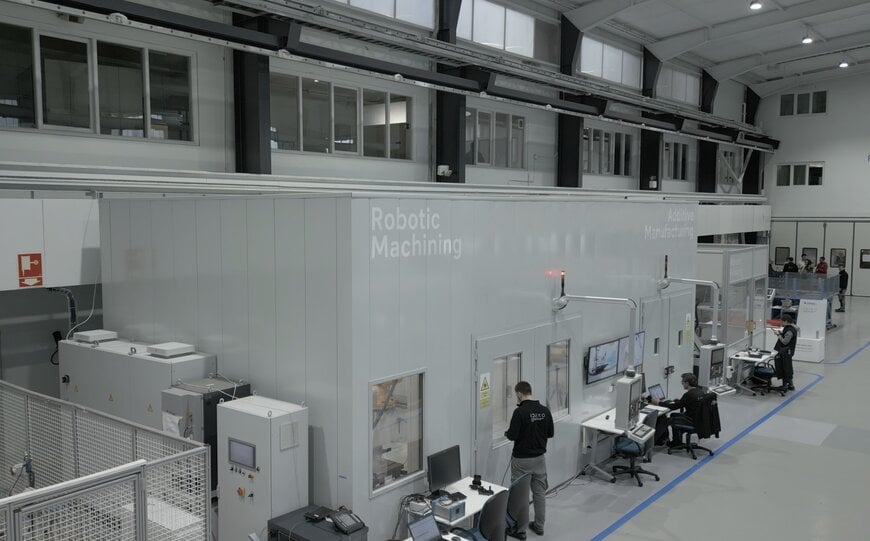
Advanced machining, robotics and data-driven production systems are increasingly central to aerospace manufacturing, where tolerances, traceability and process stability are tightly controlled. In this context, IDEKO is presenting a set of validated industrial technologies at BIEMH 2026 (2–6 March), focused on precision production and factory digitalisation for aerospace and other high-spec industries. The exhibition also coincides with the centre’s 40th anniversary, marking four decades of applied R&D in advanced manufacturing.
Robotic machining and in-line 3D inspection
One of the main demonstrators focuses on an aircraft structural component, combining robotic machining with automated dimensional inspection. A collaborative robot performs simulated measurement tasks using 3D scanning, illustrating how large aerospace parts can be inspected without dedicated metrology stations.
The cell integrates vision systems that track the robot end-effector across a large working volume and apply real-time position corrections. This approach compensates for the intrinsic stiffness limitations of industrial robots compared with conventional machine tools. The setup also includes precision fixtures and process monitoring functions designed to meet aerospace alignment and repeatability requirements.
Process data from the cell are captured and analysed to add what IDEKO describes as process intelligence. By linking sensor feedback, robot motion data and machining parameters, the system supports adaptive control strategies aimed at improving machining stability, reducing scrap and increasing operational safety. The same architecture can be transferred to other sectors with similar accuracy demands, including energy and rail.
Data platforms for complex production environments
A second aerospace-focused demonstrator centres on an engine component and represents a digitalised production scenario. Quality control is integrated directly into the process through continuous monitoring of machining variables and machine condition indicators.
Artificial Intelligence methods are applied to detect deviations in machine behaviour and correlate them with part quality data. The underlying platform supports scalable acquisition and management of machine and plant data, forming part of a broader digital supply chain strategy where production data feed back into planning, maintenance and quality systems.
According to the technical information presented, this approach improves machine availability and process productivity by identifying abnormal conditions early and reducing the number of non-conforming parts. The emphasis is on measurable production indicators such as downtime, rejection rates and process stability rather than isolated inspection results.
Multi-sensor inspection for casting and machining defects
Another system on display, MULTISense, targets automated defect detection in casting and machining. It combines multiple vision technologies to identify surface and subsurface irregularities that may not be detectable with a single sensing modality.
Such systems are relevant in aerospace and automotive supply chains where defect classification and traceability are required to meet certification and audit requirements. By integrating inspection closer to the production line, the system supports faster feedback loops between machining, quality and process engineering teams.
Controlling vibration without machine redesign
Vibration during machining remains a limiting factor in productivity and surface quality, especially when working with thin-walled or difficult-to-cut aerospace materials. IDEKO is presenting damping technologies designed to stabilise machining operations without requiring structural modifications to the machine tool.
A portable device called DynAQ is being demonstrated as a tool for measuring and diagnosing vibration issues in production equipment. It records signals from multiple sensors, displays time-domain behaviour and performs spectral analysis to help identify chatter frequencies and dynamic instabilities. This enables maintenance and process engineers to adjust cutting parameters or apply damping solutions based on measured dynamic response rather than trial and error.
Sub-micrometre surface quality under control
The exhibition also includes technologies for characterising and mitigating surface marks generated in high-precision grinding and machining. These marks, often smaller than one micrometre, can affect functional properties such as friction, wear and lubrication, which are critical in aerospace, automotive and energy components.
IDEKO is showing demonstrators that combine high-resolution surface measurement with process analysis to trace the origin of these marks. The same expertise is applied to controlled surface texturing, where engineered micro-patterns are introduced to achieve specific tribological properties.
Together, these developments position precision machining, robotics and production data analytics as interconnected elements of modern aerospace manufacturing, where dimensional accuracy, surface integrity and digital traceability must be managed within a unified production environment.
www.ideko.com
