
www.aero-defence.tech
06
'26
Written on Modified on
New Human Exploration Control Center for Moon and Mars
The German Aerospace Center (DLR) plans a dedicated human spaceflight control centre to manage future missions beyond Earth orbit, expanding operational capacity for lunar and Martian exploration.
www.dlr.de
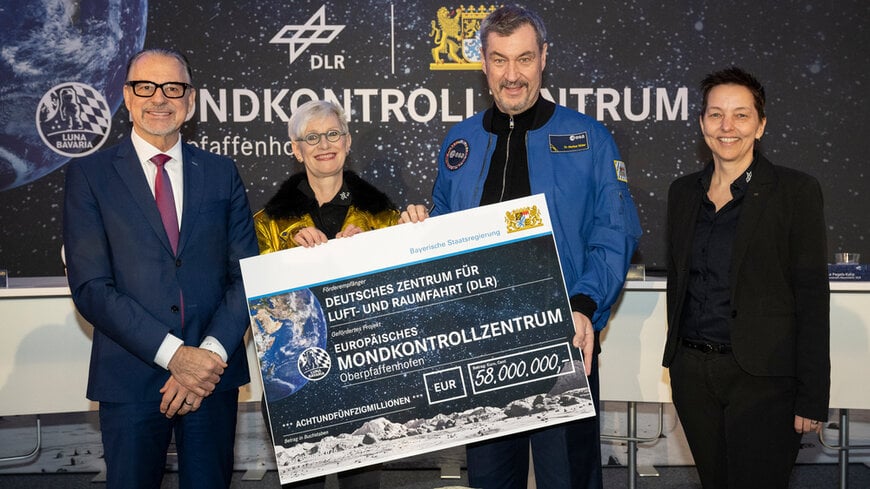
The Human Exploration Control Center (HECC) is being developed to operate and monitor human and robotic missions, including modules of the Gateway lunar orbital station and future deep-space activities. This initiative reflects growing technical demands as space agencies prepare for sustained exploration of the Moon and Mars.
Client and operational context
The Deutsches Zentrum für Luft- und Raumfahrt (DLR) is Germany’s national aeronautics and space research centre, responsible for aerospace technology development, scientific missions, and space operations. As part of the German Space Operations Center (GSOC) in Oberpfaffenhofen near Munich, DLR manages ground systems that support satellite operations and human spaceflight infrastructure, such as the Columbus Control Center that oversees the European Columbus laboratory on the International Space Station (ISS).
DLR intends to extend its control capability to missions beyond low Earth orbit, addressing the technical challenge of coordinating complex operations in lunar orbit and on long-duration deep-space missions. Current facilities are tailored to orbiting spacecraft in Earth proximity, but emerging missions to the Moon and Mars require expanded infrastructure able to handle multiple mission types and greater autonomy.
Technical challenges and goals
Mission control for human spaceflight involves real-time monitoring and command of spacecraft, habitat modules, and communication systems. Near Earth, signals can be rapidly exchanged, but deep-space operations introduce latency and autonomy requirements not fully addressed by existing ground systems. DLR’s goal is to create a centre capable of operating future spacecraft, including modules of the Gateway lunar orbital station such as the Habitat and Logistics Outpost (HALO), the International Habitation module (I-HAB), and the communication system linking lunar surface assets.
The HECC will also accommodate the development and testing of operational procedures that may be required for human missions to Mars, where communication delays of up to 40 minutes one way necessitate semi-autonomous control schemes. To support these goals, DLR plans to integrate advanced tools and support personnel in dedicated clean rooms, multi-mission control areas, and high-security server facilities.
Solution chosen and rationale
DLR selected to expand its existing GSOC infrastructure by constructing a new facility the Human Exploration Control Center. This approach leverages established expertise in mission operations and astronaut training developed through programs such as Spacelab, ISS operations, and satellite control. By building on the GSOC foundation, the HECC can integrate new functions while maintaining continuity with existing operations.
The centre’s design accommodates up to 200 staff and includes specialised areas for managing multiple missions in parallel. According to DLR leadership, this configuration is essential for handling the increased complexity of lunar and Mars missions, which involve a broader range of systems and longer operational timelines than current Earth-orbit missions.
Deployment process and institutional support
Construction of the HECC is supported by a 58 million euro grant from the Free State of Bavaria, alongside approximately 20 million euros in institutional funding from DLR. The funding agreement was formally presented to DLR executives in February 2026, marking the start of the project’s development phase. The centre is scheduled to begin construction in 2028 with operational readiness planned for 2030.
DLR will coordinate with the European Space Agency (ESA) and international partners to ensure that the HECC supports European contributions to the Artemis lunar programme and broader exploration initiatives. Collaborative development of operational procedures and long-term mission support strategies is part of this partnership.
Expected benefits and results
The HECC will enhance Europe’s autonomy in human spaceflight operations by providing a dedicated command infrastructure for lunar orbital station modules and future deep-space missions. Expanding operational capacity is expected to accelerate readiness for complex missions, improve coordination across multinational projects, and reduce dependence on external control facilities.
In the longer term, the centre’s capabilities for handling communication delays and autonomous systems will be a technical asset for planned crewed missions to Mars, where direct control from Earth is limited by signal latency. By developing procedures and hardware now, DLR aims to ensure that European mission control remains at the forefront of deep-space exploration.
www.dlr.com
