
www.aero-defence.tech
04
'26
Written on Modified on
Milrem Robotics and EOS partner to advance network-centric combat robotics
Milrem Robotics and EOS Defence Systems have signed a teaming agreement to integrate remote weapon stations with unmanned ground vehicles for enhanced mobile counter-drone and fire support.
milremrobotics.com
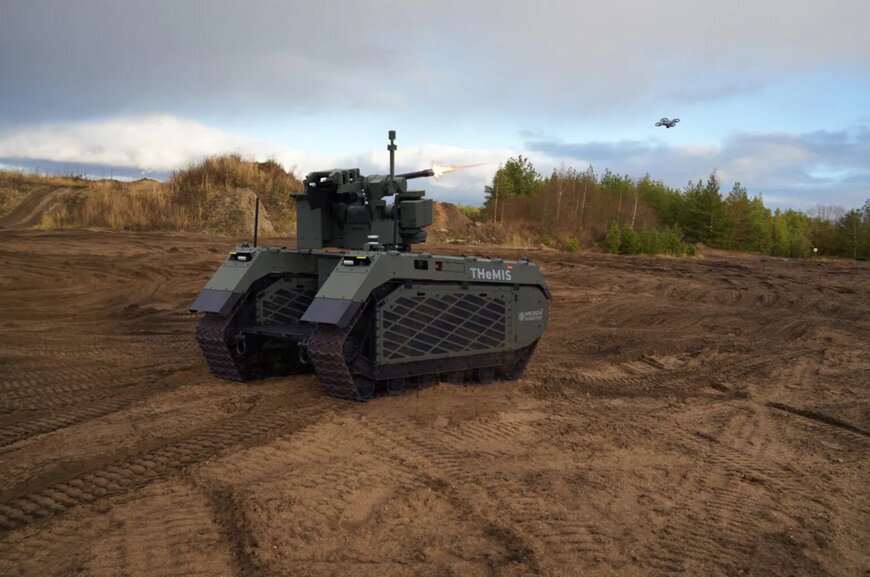
Milrem Robotics and EOS Defence Systems (EOS) have entered into a strategic teaming agreement to develop and deploy advanced unmanned ground systems (UGS). The partnership combines Milrem’s expertise in autonomous ground platforms with EOS’s precision remote weapon systems (RWS) and sensor technology. This collaboration addresses the growing requirement for mobile, layered defense systems capable of operating in contested environments where crewed platforms face high risk.
Integration of autonomous platforms and precision payloads
The cooperation focuses on the technical integration of EOS weapon systems, such as the R400 RWS, onto Milrem’s THeMIS and Type-X unmanned ground vehicles (UGVs). The THeMIS platform utilizes an open architecture and a hybrid diesel-electric drive, supporting a maximum payload of 1,200 kg. By integrating EOS’s stabilized RWS, the system enables high-precision engagement of land and aerial targets while the operator remains at a standoff distance.
Key technical objectives of the partnership include:
- Counter-UAS (C-UAS) Development: Implementing non-ITAR (International Traffic in Arms Regulations) solutions to provide mobile protection against drone threats.
- Kinetic Payload Expansion: Integrating large-caliber weapon systems, including the Northrop Grumman M230LF 30mm cannon, and missile or grenade launchers onto medium and heavy UGV platforms.
- Directed Energy Systems: Researching the implementation of laser-based capabilities on uncrewed platforms for high-accuracy effectors.
Operational implementation and industrial automation
The joint solution leverages Milrem’s Intelligent Functions Kit (MIFIK), which provides autonomous navigation capabilities including follow-me, point-to-point, and obstacle avoidance. These digital infrastructure components allow the UGVs to function as part of a network-centric combat team. The systems are designed for seamless integration into existing Battle Management Systems (BMS), ensuring interoperability with NATO-standard communication protocols and AES256 encryption for secure data links.
The partnership also facilitates the sharing of intellectual property and technical know-how to accelerate the commercialization of these technologies. Initial deployment and testing focus on markets in the Middle East, Europe, and the Asia-Pacific region, including programs in Australia and the United Arab Emirates.
Strategic impact on industrial defense
By automating high-risk combat and surveillance tasks, the cooperation aims to enhance process stability and operator safety. The modularity of the THeMIS platform allows it to be reconfigured for logistics, intelligence, or direct fire support within the same industrial framework. This flexibility reduces the logistical footprint and maintenance complexity compared to traditional crewed armored vehicles. The agreement underscores a transition toward autonomous systems as a core component of modern industrial automation within the defense sector, providing scalable and mission-ready capabilities for diverse operational requirements.
www.milremrobotics.com
The joint solution leverages Milrem’s Intelligent Functions Kit (MIFIK), which provides autonomous navigation capabilities including follow-me, point-to-point, and obstacle avoidance. These digital infrastructure components allow the UGVs to function as part of a network-centric combat team. The systems are designed for seamless integration into existing Battle Management Systems (BMS), ensuring interoperability with NATO-standard communication protocols and AES256 encryption for secure data links.
The partnership also facilitates the sharing of intellectual property and technical know-how to accelerate the commercialization of these technologies. Initial deployment and testing focus on markets in the Middle East, Europe, and the Asia-Pacific region, including programs in Australia and the United Arab Emirates.
Strategic impact on industrial defense
By automating high-risk combat and surveillance tasks, the cooperation aims to enhance process stability and operator safety. The modularity of the THeMIS platform allows it to be reconfigured for logistics, intelligence, or direct fire support within the same industrial framework. This flexibility reduces the logistical footprint and maintenance complexity compared to traditional crewed armored vehicles. The agreement underscores a transition toward autonomous systems as a core component of modern industrial automation within the defense sector, providing scalable and mission-ready capabilities for diverse operational requirements.
www.milremrobotics.com
