
www.aero-defence.tech
22
'26
Written on Modified on
GrayMatter Robotics advances AI automation for defense MRO
Finalist in the DoD Maintenance Innovation Challenge, the system targets adaptive surface preparation, coating, and inspection to reduce rework and depot turnaround time.
graymatter-robotics.com
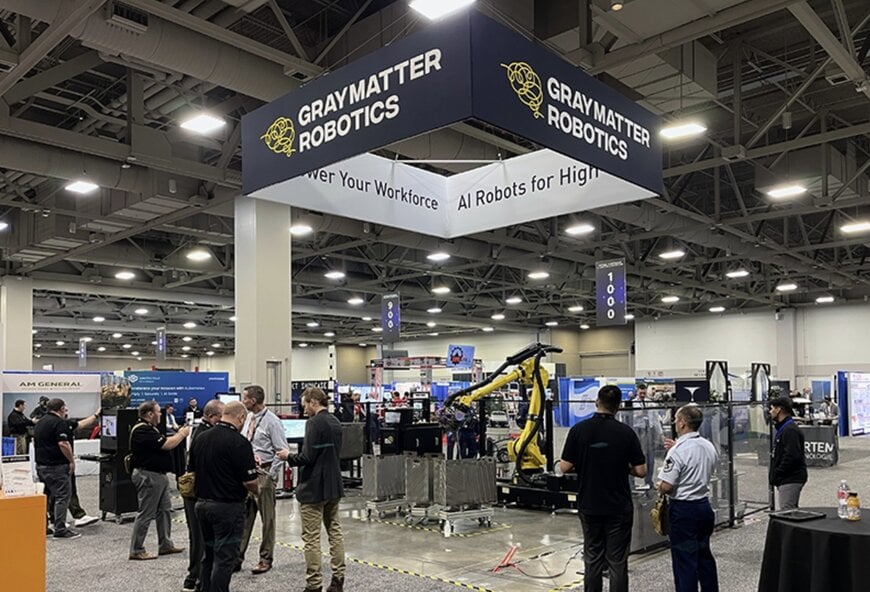
Defense maintenance depots are under pressure to shorten turnaround times while handling highly variable parts and aging platforms with constrained labor. In this context, GrayMatter Robotics was named one of five finalists in the Department of Defense Maintenance Innovation Challenge for its AI-driven robotic maintenance, repair, and overhaul (MRO) automation.
DoD challenge spotlights depot modernization priorities
GrayMatter Robotics was selected as a finalist from 59 submissions in the Department of Defense (DoD) Maintenance Innovation Challenge (MIC). The program is facilitated by the National Center for Manufacturing Sciences (NCMS) and sponsored by the Office of the Deputy Assistant Secretary for Defense–Material Readiness, with the aim of identifying technologies that can improve maintenance and sustainment outcomes.
The company is scheduled to present its approach to senior defense maintenance leaders at the 2025 DoD Maintenance Symposium, held January 20–23, 2026, at the Phoenix Convention Center in Phoenix, Arizona.
A focus on surface finishing, where labor and variability collide
Surface preparation and finishing tasks—such as sanding, blasting, and coating—remain among the most labor-intensive steps in military depot workflows. These steps are also difficult to automate at scale because defense assets vary widely in geometry and condition, from aircraft canopies to ship and submarine components.
GrayMatter’s finalist submission, titled “AI-Powered Robotic Maintenance Repair and Overhaul,” centers on using adaptive robotics to automate these variable surface finishing operations with less manual programming effort than traditional robotic systems.
GMR-AI™ platform targets geometry-agnostic automation
At the core of the approach is the company’s GMR-AI™ platform, described as enabling adaptive automation without preprogramming for each part geometry. The concept is positioned as “physics-informed AI” to support real-time adaptation during processing—an area that typically requires weeks of skilled technician time to set up when using conventional automation methods.
The intended outcome is a more deployable automation model for defense sustainment environments, where parts, tolerances, and wear patterns often differ from unit to unit.
Closed-loop workflows: preparation, coating, inspection
A key technical positioning point is workflow integration. The system is described as combining surface preparation, coating, and inspection into a unified adaptive process. In maintenance environments, this type of closed-loop setup is designed to reduce quality variation that leads to repeated prep work, coating defects, or downstream inspection failures.
GrayMatter links repeatability to specification-compliant finishes that affect coating adhesion and corrosion prevention, both of which are central to sustainment life-extension programs.
Productivity and quality claims tied to rework reduction
Within the MIC evaluation context, GrayMatter cites measurable outcomes including 10× productivity improvements and a 95% reduction in rework rates. The company also positions the automation as a labor-reduction tool for ergonomically demanding tasks, aiming to shift maintainers toward higher-value diagnostic and corrective work.
The solution is described as production-ready and already deployed at major defense contractors. GrayMatter also claims a deployment timeline of two weeks, compared with months for more traditional automation approaches.
Readiness context: backlog pressure and workforce constraints
The MIC positioning ties directly to workforce and capacity constraints affecting defense maintenance. The press material references more than 1.5 million unfilled manufacturing jobs nationally and surface finishing turnover rates exceeding 70%, framing automation as a way to sustain depot throughput when skilled labor is limited.
This matters operationally because depot flow days translate directly into fleet availability across air, land, and sea platforms.
How this fits into GrayMatter’s defense pipeline
GrayMatter states that the MIC recognition builds on existing defense work, including an AFWERX SBIR Direct to Phase II contract for Smart Robotic Canopy Sanding Systems, active engagements with multiple Air Logistics Complexes related to depot modernization, and partnerships with defense primes for submarine and aircraft maintenance.
The technology is described as dual-use, with deployments spanning aerospace, defense, and specialty vehicle sectors, and having processed millions of surface area across these domains.
www.graymatter-robotics.com
