
www.aero-defence.tech
18
'25
Written on Modified on
European Maritime Safety Agency selects Airbus Flexrotor drone
The 25kg Flexrotor VTOL drone provides 10-14 hour endurance and flexible sensor integration, enabling autonomous land or sea operations within a minimal expeditionary footprint.
www.airbus.com
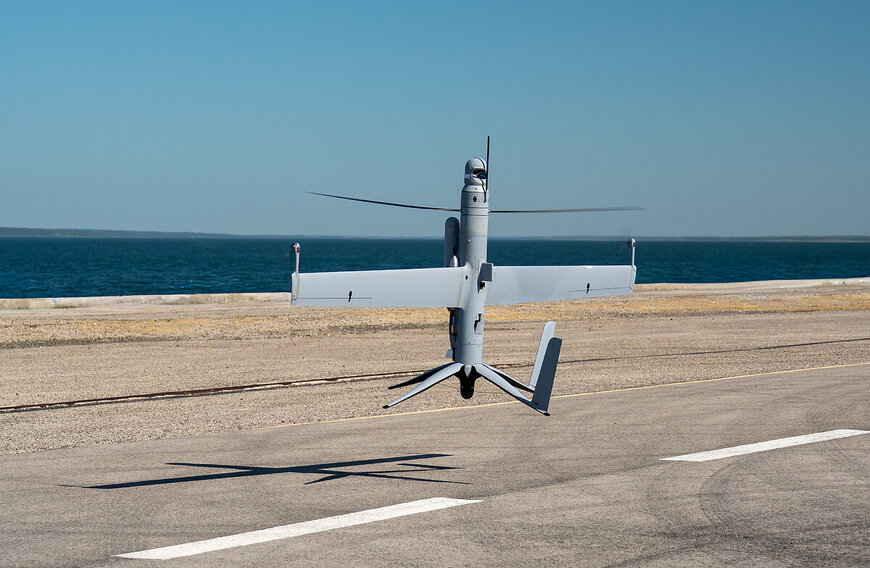
The European Maritime Safety Agency (EMSA) has contracted Airbus to supply Remotely Piloted Aircraft Systems (RPAS) services using the Flexrotor uncrewed aerial system for multipurpose maritime surveillance. The agreement positions the digital supply chain of maritime data collection to deliver extended coastal range and persistent monitoring for search and rescue, fisheries control, environmental protection, and illicit activity detection across EU maritime domains. The EMSA use case underscores the relevance of uncrewed systems for distributed coastal and high-sea operations.
Context and Contract Scope
In December 2025, EMSA awarded Airbus a framework contract valued at approximately €30 million to provide Flexrotor RPAS services tailored for maritime surveillance missions. The framework is structured over an initial two-year period with optional extensions up to four years. Services are slated to begin in 2026 and will be executed by a French service provider under Airbus oversight. The agreement enables parallel dual-operation deployments with launch capability from multiple Member State locations, and provision for scalable operations if required. The deployment model emphasizes rapid response and distributed maritime coverage across EU Member States, Norway, and Iceland.
Flexrotor Technical Characteristics
The Flexrotor is a small tactical vertical take-off and landing (VTOL) uncrewed aerial system designed for extended intelligence, surveillance, target acquisition, and reconnaissance (ISTAR) missions. With a maximum take-off weight of 25 kilograms, it achieves more than 12–14 hours of endurance in typical configurations and approximately 10 hours in EMSA’s maritime service configuration. The system supports a range of mission payloads such as electro-optical/infrared (EO/IR) sensors and radar, feeding live data streams to the EMSA RPAS data centre in near real-time for operational use by national authorities. Autonomous launch and recovery can occur from both land and sea environments within a minimal 3.7 by 3.7 meter footprint, facilitating expeditionary operations where infrastructure is limited.
Operational Integration and Data Flow
Under the EMSA contract, Flexrotor missions will deliver EO/IR and radar imagery to the RPAS Data Centre, enhancing situational awareness for member state coast guards and relevant EU institutions. This integration with the agency’s digital maritime data ecosystem aims to streamline the flow of actionable intelligence for real-time decision making. Surveillance support spans key maritime domains including search and rescue, illegal fishing oversight, environmental incident assessment, and counter-illicit trafficking activity.
Application Areas and Benefits
Deploying Flexrotor within the EMSA framework addresses several technical and operational challenges in maritime domain awareness. The extended endurance and multi-sensor capabilities improve persistent wide-area coverage without reliance on traditional crewed aircraft patrols. The autonomous VTOL architecture reduces dependence on specialized launch infrastructure, enabling operations from coastal sites and vessels alike. By standardizing data delivery into EMSA’s centralized RPAS data platform, member states can coordinate surveillance efforts, reduce duplication, and accelerate response times across disparate maritime regions.
Use Cases in Maritime Surveillance
In practice, Flexrotor supports continuous monitoring during search and rescue missions where timely EO/IR data can inform life-saving coordination. For fisheries oversight, the system’s radar and imaging payloads provide evidence of illegal, unreported, and unregulated (IUU) activities in zones beyond conventional maritime patrol reach. Environmental protection missions benefit from extended wide-area surveillance, enabling early detection of spill events or pollution vectors. The combined sensor suite contributes to comprehensive maritime domain awareness with measurable operational outputs.
Industry Relevance
The EMSA selection of the Flexrotor reflects broader trends in uncrewed systems adoption for maritime security and environmental monitoring. Its extended endurance, flexible launch and recovery profile, and real-time data integration illustrate how tactical VTOL drones are being embedded into distributed surveillance architectures. While other unmanned platforms exist, Flexrotor’s endurance and multi-sensor integration across coastal and open sea workflows provide objective comparative benchmarks for extended maritime operations.
The contract solidifies the operational role of uncrewed aerial systems in European maritime surveillance and represents a step toward harmonizing technical capability with the agency’s expanding surveillance requirements.
www.airbus.com
