
www.aero-defence.tech
05
'26
Written on Modified on
BluMetric Redesigns Military ROWPU for Extended Deployment
Canadian Armed Forces Implement Danfoss High-Pressure Pumps to Extend System Maintenance Intervals to 8,000 Hours and Secure Predictable Field Potable Water Production.
www.danfoss.com
Application Area: Reverse Osmosis Desalination & Purification, High-Pressure Pumping, Containerized Water Treatment Systems
Industry Sector: Defense, Military Engineering, Disaster Relief
For military forces operating in remote, variable, and resource-constrained environments, the availability of potable water is a vital operational requirement. The Canadian Armed Forces (CAF) rely on containerized Reverse Osmosis Water Purification Units (ROWPUs) as a core deployable capability to supply water for personnel and disaster-affected populations. However, legacy systems introduced in the mid-1990s suffered from intensive maintenance demands and unsustainable service cycles. Frequent downtime and logistical complexities surrounding spare parts availability carried immediate consequences for field operations.
The primary operational hurdle stemmed from the legacy positive displacement pumps, which required rebuild kits at least every 1,500 hours, and in some cases as frequently as 500 hours. Across a fleet of more than 20 systems, this created a continuous cycle of maintenance, requiring additional units to be held in rotation and placing an unnecessary burden on personnel who were not pump specialists.
To resolve these vulnerabilities, BluMetric worked with the CAF on a comprehensive system review and redesign. The goal was to reduce intervention frequency, simplify field maintenance, and maximize operational continuity. BluMetric achieved this by introducing an integrated, containerized architecture that utilizes high-performance high-pressure pumps to eliminate obsolescence and withstand demanding environments ranging from arctic to tropical conditions.
End-to-End System Integration and Parallel Redundancy
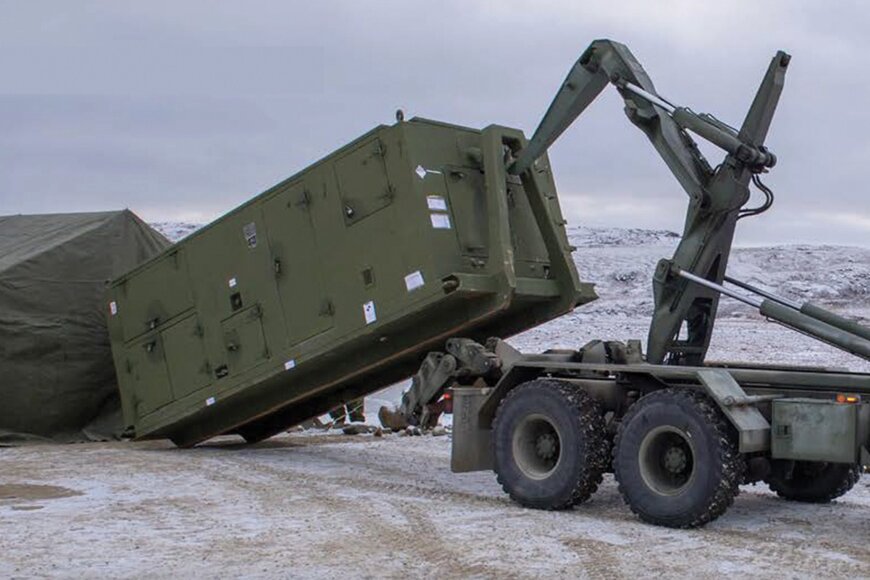
BluMetric transformed the ROWPU into a fully self-contained unit housed inside a customized 20-foot shipping container. The system integrates all necessary subsystems required to deploy and begin producing water within hours, including:
- Feed pumps and advanced pre-filtration arrays
- High-pressure pump manifolds and reverse osmosis membranes
- Post-treatment systems, onboard tools, and operational consumables
A critical element of the technical redesign was replacing the high-maintenance legacy pumps with a parallel configuration of three Danfoss APP 5.1 high-pressure pumps. This parallel configuration delivers the high operating pressures necessary for reverse osmosis while providing built-in mechanical redundancy. If one pump must be taken offline, the remaining units continue to operate, allowing uninterrupted potable water production.
Extended Service Lifecycles and Operational Continuity
The deployment of the axial piston pump technology yielded immediate operational results. The initial inspection interval for the high-pressure pumping subsystem was extended to 8,000 hours—representing a significant change in lifecycle durability compared to the legacy 500-hour threshold. Furthermore, the system is projected to achieve complete rebuild intervals of up to approximately 25,000 hours.
This engineering approach also optimized upstream and downstream components. Improvements in pre-filtration and system-level integration extended reverse osmosis membrane lifespans to between five and seven years.
Operating as a standalone capability, a small deployment team can establish a daily output of approximately 210 m³/day, which is sufficient to sustain 1,000 to 1,500 personnel. By delaying maintenance intervals from hundreds of hours to thousands, the CAF has reduced its dependency on specialized spare parts supply chains and simplified field servicing, aligning asset behavior with the requirements of mission-critical deployments.
Additional Context
This section details technical specifications and competitive benchmarking not included in the original application story.
Technical Specifications
The Danfoss APP (Axial Piston Pump) series relies on a positive displacement design where multiple pistons are arranged parallel to a drive shaft inside a rotating cylinder block. As the block rotates, shoe pads slide against an inclined swash plate, forcing the pistons to reciprocate and draw fluid through low-pressure ports before compressing it out through the high-pressure manifold.
The APP 5.1 variant is engineered explicitly for reverse osmosis applications. It utilizes the pumped medium (water) for lubrication instead of traditional oil lubricants, completely eliminating the risk of cross-contamination within the potable water loop. The construction relies heavily on high-grade Duplex and Super Duplex stainless steel for all wetted parts to resist corrosion and cavitation damage under high-pressure conditions. The axial piston mechanism functions with fixed clearance dimensions, ensuring a volumetric efficiency that regularly exceeds 90%.
Extended Service Lifecycles and Operational Continuity
The deployment of the axial piston pump technology yielded immediate operational results. The initial inspection interval for the high-pressure pumping subsystem was extended to 8,000 hours—representing a significant change in lifecycle durability compared to the legacy 500-hour threshold. Furthermore, the system is projected to achieve complete rebuild intervals of up to approximately 25,000 hours.
This engineering approach also optimized upstream and downstream components. Improvements in pre-filtration and system-level integration extended reverse osmosis membrane lifespans to between five and seven years.
Operating as a standalone capability, a small deployment team can establish a daily output of approximately 210 m³/day, which is sufficient to sustain 1,000 to 1,500 personnel. By delaying maintenance intervals from hundreds of hours to thousands, the CAF has reduced its dependency on specialized spare parts supply chains and simplified field servicing, aligning asset behavior with the requirements of mission-critical deployments.
Additional Context
This section details technical specifications and competitive benchmarking not included in the original application story.
Technical Specifications
The Danfoss APP (Axial Piston Pump) series relies on a positive displacement design where multiple pistons are arranged parallel to a drive shaft inside a rotating cylinder block. As the block rotates, shoe pads slide against an inclined swash plate, forcing the pistons to reciprocate and draw fluid through low-pressure ports before compressing it out through the high-pressure manifold.
The APP 5.1 variant is engineered explicitly for reverse osmosis applications. It utilizes the pumped medium (water) for lubrication instead of traditional oil lubricants, completely eliminating the risk of cross-contamination within the potable water loop. The construction relies heavily on high-grade Duplex and Super Duplex stainless steel for all wetted parts to resist corrosion and cavitation damage under high-pressure conditions. The axial piston mechanism functions with fixed clearance dimensions, ensuring a volumetric efficiency that regularly exceeds 90%.
Comparison with Alternative Technology Providers
When comparing the Danfoss axial piston architecture with other market alternatives, distinct market positions emerge across alternative product categories:
- Alternative Axial Piston Pumps: Emerging alternatives within the water-lubricated axial piston category have introduced direct cross-compatible or equivalent pump options for reverse osmosis and water mist applications. While these alternative options target comparable structural parameters—using full stainless steel construction and oil-free water lubrication—they are typically position-benchmarked based on shorter commercial track records, lower initial acquisition costs, and expedited delivery lead times rather than historical longevity.
- Industrial Reciprocating Triplex Pumps: Traditional triplex plunger pumps are established, highly robust alternatives for high-pressure reverse osmosis systems. Although they provide exceptional mechanical reliability, their reliance on oil-lubricated crankcases, manual seal packing adjustments, and periodic plunger servicing means they cannot compete with the 8,000-hour maintenance-free operational interval provided by water-lubricated axial systems. Additionally, their pulsating discharge profile demands auxiliary mitigation hardware that expands the system footprint.
- Multi-Stage Centrifugal Technology: Multi-stage centrifugal high-pressure pumps are common choices in large-scale industrial water purification facilities. However, when evaluated against axial piston units within deployable, modular containers, centrifugal alternatives exhibit lower volumetric efficiencies at lower flow rates and cannot match the power-to-weight ratio needed for high-mobility, space-constrained tactical platforms.
