

www.aero-defence.tech
16
'26
Written on
Modified on
Leonardo News
Leonardo Unveils Cyber Defence Suite for Multi-Domain Protection
New integrated solution safeguards military platforms, mission systems and critical infrastructure against evolving cyber threats.
www.leonardo.com
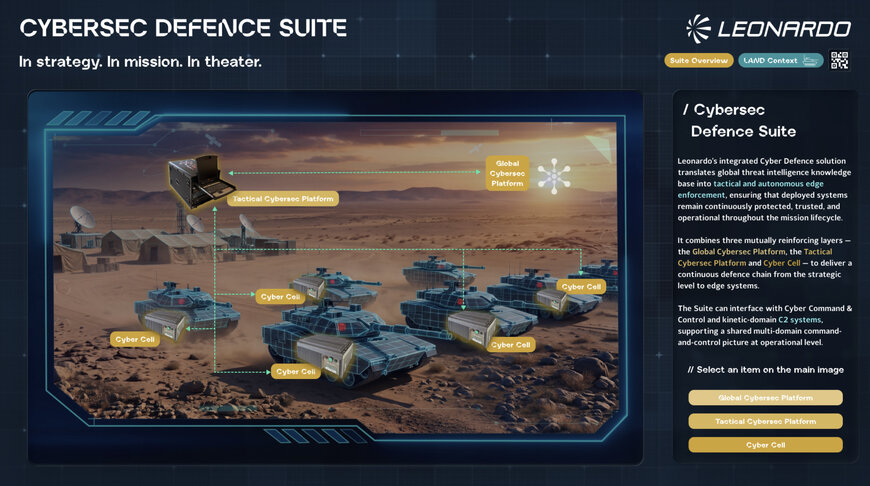
At the Eurosatory exhibition held from June 15 to June 19, 2026, in Paris, Leonardo introduced an integrated software framework designed to secure military operational technology and digital communication networks across land, sea, air, and space assets. The technology addresses vulnerabilities arising from increased interconnectivity and distributed sensor networks within modern defence frameworks.
Architecture of the Distributed Security Network
Modern military operations rely heavily on an interconnected digital supply chain where tactical platforms continuously exchange data. This high interoperability expands the potential attack surface, particularly when integrating legacy hardware with modern digital architectures. Leonardo has developed the Cyber Defence Suite to mitigate these risks by establishing a layered, federated defense mechanism that operates across strategic, tactical, and operational levels.
The system function relies on a bidirectional information flow. At the strategic level, the Global Cybersec Platform functions within a remote coordination centre to perform threat intelligence and aggregate global security data. This platform distributes cryptographic updates and threat definitions downward. At the tactical level, deployed at logistics bases, the Tactical Cybersec Platform manages peripheral nodes and maintains operational synchronisation.
Operational Autonomy at the Tactical Edge
For edge deployment, individual platforms utilise an onboard Cyber Cell. This unit operates autonomously to monitor and protect local hardware independently of external connectivity.
The system functions in both synchronous and asynchronous modes to accommodate unstable communication links. Operational telemetry is collected locally by the Cyber Cell and transmitted upward to the tactical and strategic layers when connectivity is established. This architecture applies standard cybersecurity protocols to specialized military environments, including armoured vehicles, naval platforms, avionics mission systems, and space ground control segments.
The deployment of this architecture allows military assets to maintain integrity during electronic warfare or communication degradation, ensuring that localized malware or cyber disruptions do not propagate across the wider network.
Additional Context:
This section details technical specifications and competitive benchmarking not included in the original product announcement
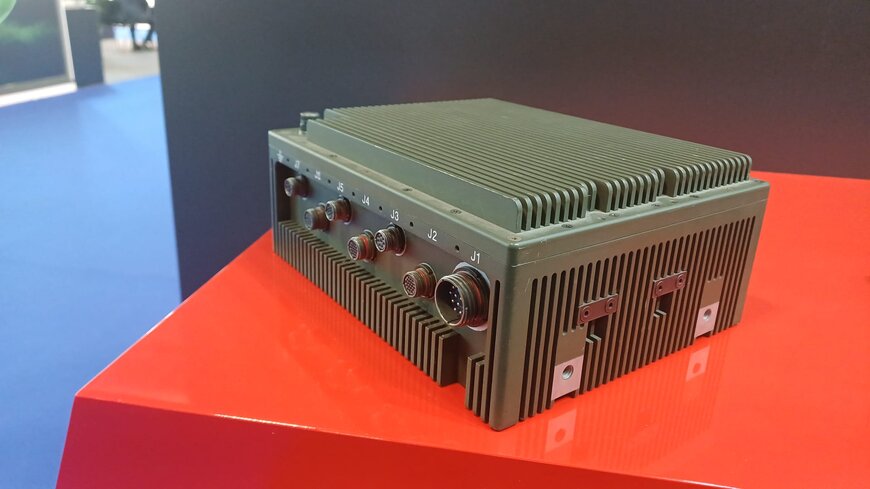
The protection of military operational technology requires adherence to strict real-time constraints and ruggedized standards, differing significantly from enterprise IT security. Leonardo's multi-layered approach competes directly with established military cyber resilience frameworks, such as the Thales Nexium Defence Cloud Cyber solution and Northrop Grumman's resilient mission systems architectures.
While enterprise systems rely heavily on continuous cloud connectivity for threat signature updates, military edge platforms require decentralized intrusion detection systems. Comparable frameworks utilize military-grade hardware complying with MIL-STD-810H environmental testing and MIL-STD-461G for electromagnetic compatibility. Furthermore, the segregation of data across different classification domains within a single federated suite requires evaluation against Cross Domain Solution metrics and Common Criteria Evaluation Assurance Levels, typically EAL4+ or higher for defence-grade networks. Leonardo’s approach utilizes the tactical platform layer to bridge the gap between strategic command centers and disconnected edge nodes, a mechanism similar to the data-diode and software-defined perimeter technologies used by competitors to prevent lateral threat movement across the automotive data ecosystem of land vehicles and avionics buses like MIL-STD-1553.
Edited by Natania Lyngdoh, Induportals editor, assisted by AI.
www.leonardo.com
