

www.aero-defence.tech
10
'26
Written on
Modified on
Milrem Robotics News
Autonomous Robotic Systems for Multi-Layered Border Defense Operations
Milrem Robotics introduces a robotised defense concept integrating unmanned ground vehicles and command systems to secure border zones.
milremrobotics.com
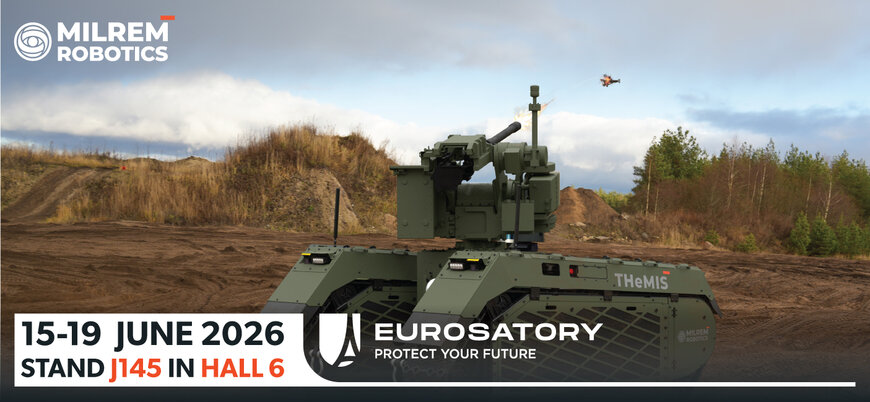
Milrem Robotics has introduced a robotic and autonomous systems architecture engineered for the Eastern Flank Deterrence Initiative. The solution integrates unmanned ground vehicles and centralized command software to establish multi-layered border defense and counter-unmanned aerial systems (C-UAS) networks.
Operational Architecture and Border Defense
The concept establishes a dedicated robotic zone along the border spanning from Finland to Poland. Instead of relying on massed human formations, the architecture utilizes the rapid deployment of unmanned systems from protected positions to prepare the battlespace. A resilient communications network links existing intelligence, surveillance, and reconnaissance (ISR) assets with autonomous ground and aerial vehicles. This integration enables continuous situational awareness and immediate response to aerial threats before they reach conventional human forces.
System Integration and Hardware Components
Central to this operational concept is the ARCOS command and control system, which manages the coordinated deployment of autonomous platforms and integrated payloads within a broader battle management framework. The hardware deployment utilizes unmanned ground vehicles, such as the THeMIS platform, for forward observation and initial contact operations. For higher-intensity combat engagements, the architecture incorporates the HAVOC Robotic Combat Vehicle. These systems are equipped to deliver direct fire, precision strikes, and counter-drone interventions while supported by conventional long-range artillery.
Strategic Deployment and Risk Mitigation
The primary operational objective is to construct a persistent defensive layer where robotic systems make initial contact and absorb high-risk engagements. This delays adversary progression and provides operational command with additional decision-making time while reducing the financial and political burden on participating nations. Kuldar Väärsi, CEO of Milrem Robotics, explained the strategic positioning of the technology: "Robotising the Eastern Flank allows NATO to create a persistent defensive layer where unmanned systems make first contact, absorb losses, and buy time for decision-making—without immediately putting soldiers at risk." The system and its enabling technologies will be presented at the Eurosatory 2026 defense exhibition in Paris.
Additional Context: This section details technical specifications and competitive benchmarking not included in the original product announcement
In the defense robotics sector, the development of unmanned ground vehicles (UGVs) and robotic combat vehicles (RCVs) for border defense represents a highly competitive market segment. Milrem Robotics competes with defense contractors such as Rheinmetall AG and BAE Systems to supply autonomous hardware for NATO interoperability programs. The HAVOC robotic combat vehicle utilized for high-intensity engagements within this architecture operates as an 8x8 platform featuring a hybrid electric drive, a curb weight of 20 tonnes, and a maximum payload capacity of 5 tonnes. Designed to support heavy armaments, including 30mm autocannons and missile launchers, the platform maintains off-road speeds of up to 50 km/h and a maximum road speed of 110 km/h. This heavy-duty operational footprint provides a scalable contrast to the company's established THeMIS UGV, which is a lighter, modular system designed primarily for logistics and forward reconnaissance.
Edited by Lekshman Ramdas, Induportals editor – adapted by AI.
www.milremrobotics.com
