

www.aero-defence.tech
11
'26
Written on
Modified on
HENSOLDT News
Software-defined orchestration networks optimize cross-domain multi-sensor data fusion
HENSOLDT deploys an integrated multi-domain tactical simulation environment to validate network resilience.
www.hensoldt.net
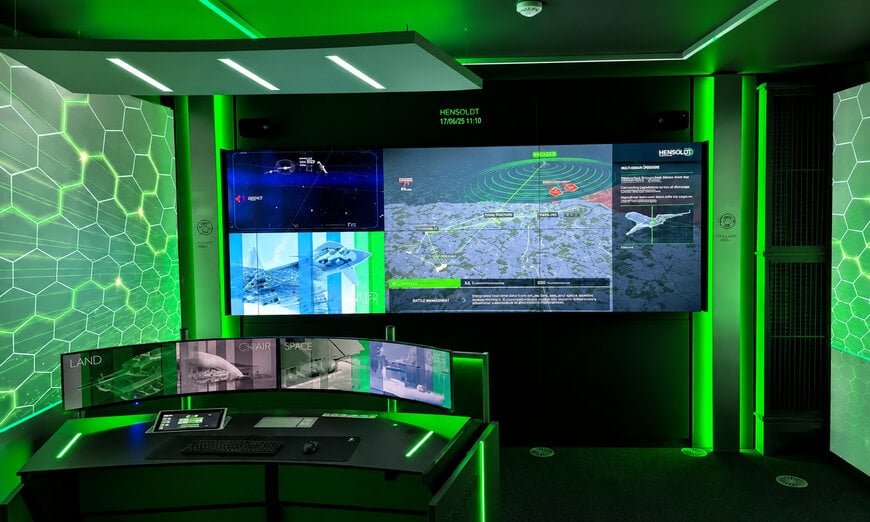
HENSOLDT has revealed its multi-domain operations development platform to validate the real-time integration of mixed physical and simulated sensor nodes. This orchestration architecture provides a unified data fusion framework linking heterogeneous air, sea, and land transceivers into a shared tactical network to support secure command-and-control operations.
Mixed-signal virtualization and hardware-in-the-loop simulation topologies
The cross-domain architecture relies on a specialized simulation framework configured to map and virtualize diverse telemetry streams within a uniform scenario grid. By deploying hardware-in-the-loop interfaces, the software environment unifies raw signal feeds from live deployed sensors alongside simulated effector arrays. The digital core translates disparate sensor protocols into standardized tracking tracks, allowing engineers to test novel software components before physical deployment.
The physical configuration is divided between two operator workstations, an interactive touch-sensitive mission table for spatial layout planning, and a large-format screen wall for real-time situational tracking. To ensure high portability across active test staging areas, the system is deployed in one static hub, two mobile units housed in ruggedized transport containers, and a fully mobile transit variant designed for field installation.
Heterogeneous node routing and anti-jamming mitigation strategies
The central data processing backbone is sustained by a dedicated cross-domain software suite that manages the high-throughput routing demands of decentralized node networks. During live drone defense scenarios, the routing matrix dynamically correlates data streams across multi-spectral air, sea, and ground sensors to maximize spatial tracking boundaries and mitigate single-point localized electronic jamming.
Automated packet prioritization metrics ensure that defensive tracking arrays and target allocation logs bypass standard diagnostics traffic, maintaining deterministic communication cycle times below operational latency targets. The open application programming interface permits rapid integration of third-party radar, optronic, and acoustic sensors without requiring modifications to the primary network control layer.
Additional Context: This section details technical specifications and competitive benchmarking not included in the original product announcement
Within the global defense simulation and tactical command market, this software-defined integration architecture enters direct competition with advanced orchestration platforms such as the Saab 9AIR TOPS combat management environment or the Raytheon Solipsys tactical display framework. Objective technical benchmarking shows that while legacy command networks frequently require rigid, hardware-dependent interface modules to bind new sensors into existing tracking architectures, HENSOLDT's use of the open core and simulation frameworks allows third-party transceivers to be virtualized and integrated within hours via an open API structure.
Furthermore, the dual static and deployable configuration provides an agile staging ground for validating network resilience compared to fixed center-bound environments. However, maintaining real-time deterministic synchronization between live physical sensor feeds and simulated effector arrays under full network loads places extreme computing demands on the central data bus, often necessitating high-throughput fiber optic backbones to match the ultra-low latency values achieved by purely synthetic closed-loop software environments.
Edited by Sucithra Mani, Induportals editor – adapted by AI.
www.hensoldt.net
