
www.aero-defence.tech
11
'26
Written on Modified on
3D Printed Microvanes Help the U.S. Air Force Cut C-17 Fuel Costs
Developed with Stratasys technology, the aerodynamic modification reduces drag and is projected to save more than $14 million annually.
www.stratasys.com
Application area: aircraft aerodynamics, additive manufacturing, fuel-efficiency optimisation
Industry sector: aerospace, defence
The U.S. Air Force operates the C-17 Globemaster III for strategic airlift missions, including troop and cargo transport, humanitarian operations and rapid deployment. The aircraft is used across the Air Force, Air National Guard and Air Force Reserve.
A key efficiency challenge is the C-17's upswept cargo-door section, which generates aerodynamic drag and increases fuel consumption. Across a large fleet, even a relatively small reduction in drag can translate into significant fuel and operating cost savings.
The Air Force therefore sought a low-cost modification that could improve aircraft fuel efficiency without affecting availability or limiting the C-17's ability to perform demanding missions, including aerial refuelling, assault-strip operations and airdrops.
3D-printed microvanes reduce drag
The Air Force Operational Energy and Air Mobility Command advanced the evaluation of 3D-printed microvanes developed through collaboration between the Air Force Research Laboratory, private industry and the Air Force Lifecycle Management Center.
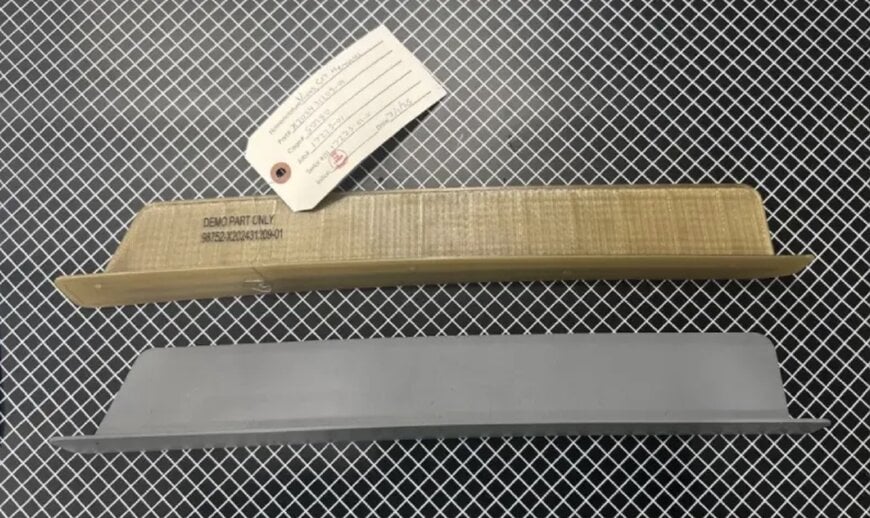
The thin, blade-like devices are designed to modify airflow around the C-17's rear cargo-door section. Each microvane measures approximately 102 × 406 mm, and twelve are installed on the aircraft's rear exterior using adhesive bonding.
The components are manufactured using Stratasys additive manufacturing technology, with an F900 3D printer and Antero 800NA aerospace-grade engineering thermoplastic. The combination provides a method for producing the aerodynamic components without requiring major structural modifications to the aircraft.
Improving fuel efficiency without major aircraft modifications
The microvanes alter airflow around the upswept cargo-door geometry, reducing the drag generated in this area. Because the devices are relatively small and bonded to the aircraft exterior, the modification can be implemented without extensive changes to the aircraft structure.
The approach also provides a way to apply additive manufacturing to an operational aircraft fleet, where modifications must meet stringent requirements for durability, performance and compatibility with existing mission profiles.
Results
Testing of C-17 aircraft equipped with the microvanes demonstrated a 1% reduction in aerodynamic drag and fuel consumption compared with unmodified aircraft.
If deployed across the U.S. Air Force's C-17 fleet, including Air National Guard and Air Force Reserve aircraft, the technology is projected to reduce annual fuel costs by more than $14 million. The projected return on investment is approximately seven months, based on fuel savings.
The project demonstrates how a relatively small 3D-printed aerodynamic component can be used to improve the operating efficiency of an existing aircraft fleet without requiring a major redesign.
Edited by Romila DSilva, Induportals Editor, with AI assistance.
www.stratasys.com
