
www.aero-defence.tech
02
'26
Written on Modified on
Stealth Validation Advances Collaborative Combat Aircraft Capability
Boeing demonstrates how the MQ-28 platform improves survivability and operational flexibility for future air force missions.
www.boeing.com
Application areas: Collaborative combat aircraft, military aviation, autonomous air systems
Industry sectors: Defence, aerospace, military aviation
Air forces are increasingly seeking autonomous and collaborative combat aircraft capable of operating in contested environments while reducing risk to crewed platforms. These aircraft must perform missions such as surveillance, electronic warfare and force multiplication while remaining difficult for adversary radar systems to detect.
To support these requirements, Boeing has continued the development of the MQ-28 Ghost Bat collaborative combat aircraft, a platform designed to operate alongside existing crewed aircraft and extend mission effectiveness.
Radar signature reduction as a key operational objective
One of the principal challenges for collaborative combat aircraft is survivability in environments protected by advanced air defence systems. Reducing radar detectability allows aircraft to operate closer to threats while lowering the probability of detection, tracking and engagement.
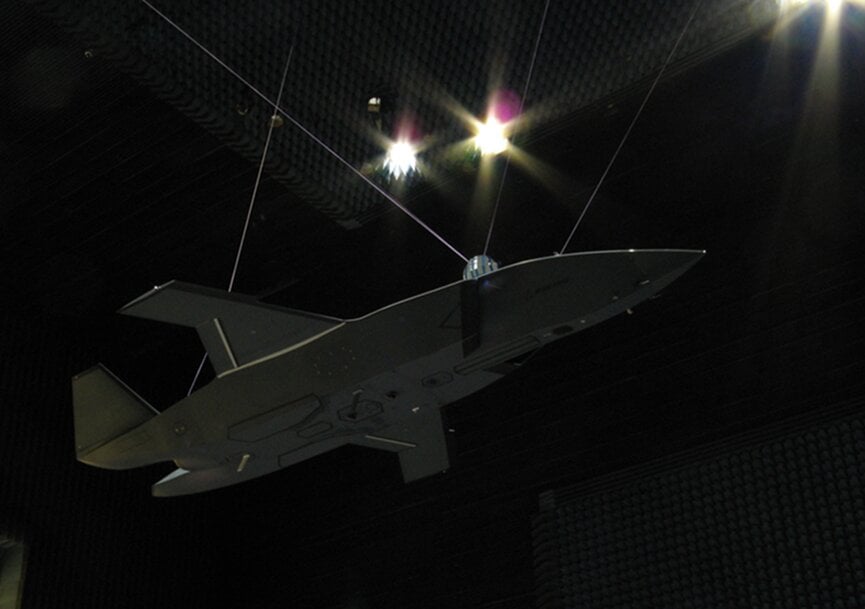
To validate the aircraft's low-observable characteristics, Boeing conducted Radar Cross Section (RCS) testing on the MQ-28. The objective was to generate objective and repeatable data regarding radar detectability and survivability performance.
Validation of stealth performance
RCS testing evaluates how strongly an aircraft reflects radar energy from different angles, including elevation, azimuth and roll positions. The resulting data helps validate design assumptions, support certification activities and inform future operational tactics.
According to Boeing, the testing confirmed that the MQ-28's design, manufacturing processes and material selections effectively reduce radar detection. Lower radar visibility decreases the distance at which enemy radar systems can detect and engage the aircraft, improving survivability during operations in contested airspace.
Combining autonomy and low observability
The MQ-28 combines stealth characteristics with advanced autonomy and artificial intelligence capabilities. The aircraft is intended to work with crewed platforms, carrying out selected missions independently while supporting broader force objectives.
“The combination of a highly capable platform, stealth features, advanced autonomy and artificial intelligence provides unprecedented ability for air forces to extend their mission effectiveness and operational flexibility,” said Brad Thompson, Director for Phantom Works Australia.
Flight testing supports operational maturity
Development of the MQ-28 began in 2017, with the first flight completed in 2021. Since then, the aircraft has accumulated more than 150 flight tests and demonstrations.
Recent milestones include coordinated operations involving multiple MQ-28 aircraft, interoperability testing with the E-7A Wedgetail airborne early warning aircraft, autonomous engagement of airborne targets in cooperation with an F/A-18F, and international operational testing at Point Mugu, California.
These demonstrations were conducted to validate autonomous operations, aircraft teaming capabilities, rapid deployment procedures and sustained operations from allied locations.
Supporting future collaborative combat operations
The successful validation of the MQ-28's stealth performance represents another step toward operational deployment of collaborative combat aircraft within future air force fleets. By combining reduced radar detectability, autonomous operation and interoperability with existing military platforms, the aircraft is intended to support a range of missions while reducing operational risk for crewed assets.
Edited by Sucithra Mani, Induportals editor – adapted by AI.
www.boeing.com
